
Views: 0 Author: Site Editor Publish Time: 2026-08-14 Origin: Site


Material thickness in flexible packaging is a precise balancing act. A fraction of a millimeter dictates product survivability and profit margins. When configuring packaging specifications, determining the exact material gauge ensures the final container performs under the stress of transit, storage, and retail display. Under-specifying bag thickness leads to catastrophic ruptures, compromised barrier properties, and retail spoilage. Over-specifying adds unnecessary raw material costs, increases freight weight, and causes thermal sealing failures on automated packaging lines.
Selecting the optimal thickness for flat bottom bags requires evaluating product weight, distribution rigor, and material composition. This guide breaks down how to calculate exact thickness requirements to balance structural integrity with cost efficiency. You will learn how to match micron ratings to product volumes, navigate multi-layer laminations, and validate specifications through physical testing.
Thickness vs. Barrier Independence: Overall thickness (measured in mils or microns) dictates physical strength, but barrier performance (oxygen/moisture) relies on the specific laminate layers, not just raw thickness.
Weight-to-Thickness Ratios: Standard retail items (under 1 kg) typically require 3.0 to 4.0 mil, while high-capacity applications like 6–10 kg flat bottom bags demand 5.0 to 6.0+ mil with reinforced seals.
Machinability Constraints: Thicker materials require higher sealing temperatures and longer dwell times, which may necessitate equipment upgrades or slow down production speeds.
Testing is Non-Negotiable: Theoretical thickness specs must be validated through standardized drop testing and transit simulation before full-scale procurement.
The physical composition of the packaged product directly dictates the required tensile strength and puncture resistance of the bag. Sharp or abrasive products create internal stress points against the packaging film. Roasted coffee beans, dog kibble, hardware components, and dehydrated foods possess rigid edges. These edges constantly press against the inner sealant layer during handling and vibration. Insufficient thickness results in micro-punctures. These microscopic tears destroy the modified atmosphere inside the package, leading to rapid oxidation and spoilage. A thicker inner polyethylene (PE) layer absorbs these impacts. It acts as a cushion that prevents sharp edges from penetrating the barrier layers.
Field experience shows that a 3.0 mil bag holding sharp dehydrated pasta will fail drop tests at 1 meter. Upgrading the inner LLDPE layer by just 1.0 mil changes the failure rate from 15% to near zero. The polymer absorbs the kinetic energy of the sharp edges. You must match the inner sealant web thickness to the abrasiveness of the product.
Thickness fundamentally contributes to the bending stiffness and overall rigidity of the flexible container. Flat Bottom Bags rely heavily on material stiffness to maintain an upright posture on retail shelving. Without adequate thickness, the material lacks the structural memory to stand vertically. This results in sagging, wrinkling, or complete collapse under the product's own weight. A bag that slumps on the shelf damages brand perception and reduces the visibility of printed graphics. The correct gauge ensures the side gussets remain crisp and the front panel stays taut.
Retailers frequently reject shipments if the packaging fails to merchandise correctly. A 250g coffee bag using a 2.5 mil structure will inevitably buckle after a few days on the shelf. The material simply cannot fight gravity. Moving to a 4.0 mil structure provides the necessary backbone. The outer PET layer combined with a robust PE core creates a rigid cylinder effect when filled.
The architectural advantage of a flat bottom design is its stable, rectangular footprint. This stability depends entirely on the material's ability to handle vertical loads. As product settles into the base of the bag, gravitational force pushes outward against the bottom gusset and lower side seams. Appropriate material thickness prevents the bottom gusset from bowing outward or rounding off. When the material is too thin, the base distorts, causing the bag to lean or tip over. Proper thickness ensures the package maintains a perfectly flat footprint, allowing for stable stacking and uniform display.
A common fallacy in flexible packaging is equating physical thickness directly with barrier performance. Thicker bags offer superior physical protection against drops and abrasions. They do not automatically block oxygen or moisture better than thinner bags. A very thin layer of Ethylene Vinyl Alcohol (EVOH) or aluminum foil provides exponentially better gas and moisture barriers than a thick layer of standard Linear Low-Density Polyethylene (LLDPE). Increasing thickness using only structural polymers will not extend shelf life for oxygen-sensitive goods. The barrier is determined by the specific chemical properties of the laminate layers. The thickness dictates the mechanical durability.
To navigate material selection effectively, thickness specifications are categorized into three primary duty ratings. These ranges align with specific product weights and handling requirements.
Light duty structures are engineered for low-density, lightweight applications. They fit loose leaf teas, light snacks, freeze-dried goods, and products weighing under 500 grams. The primary characteristics of this range include high flexibility, lower raw material consumption, and rapid heat-sealing capabilities. Because the material is thin, thermal energy transfers quickly through the layers. This allows packaging machinery to operate at maximum speeds. This thickness provides limited structural support for self-standing displays. It works best for smaller formats where vertical rigidity is less of a factor.
The medium duty range represents the industry standard for retail packaging. It is utilized for specialty coffee, standard retail pet treats, granular powders, and organic grains weighing between 500 grams and 2 kilograms. This thickness profile offers the optimal balance of vertical rigidity, barrier integration, and thermal processing efficiency. At 4.0 mil, the material is thick enough to support complex multi-layer laminations. This includes foil or metallized films. It remains pliable enough to run smoothly on standard form-fill-seal equipment. It provides excellent shelf presence without over-engineering the package.
Heavy duty configurations are reserved for demanding applications that require exceptional mechanical strength. They handle bulk agricultural products, heavy pet food, industrial powders, and coarse minerals. The defining characteristics of heavy duty bags include maximum puncture resistance and high tolerance to drop impacts. The robust nature of these films prevents catastrophic failure during rough transit. Processing materials exceeding 4.5 mil requires specialized heavy-duty sealing jaws, higher temperature settings, and longer heating cycles to ensure the seal layers melt and fuse completely.
Duty Rating | Thickness (mil) | Thickness (microns) | Ideal Product Weight | Common Applications |
|---|---|---|---|---|
Light Duty | 2.0 – 3.0 | 50 – 75 | Under 500g | Tea, freeze-dried snacks, light powders |
Medium Duty | 3.0 – 4.5 | 75 – 115 | 500g – 2kg | Coffee, pet treats, grains, retail foods |
Heavy Duty | 4.5 – 6.0+ | 115 – 150+ | 2kg – 10kg+ | Bulk pet food, agricultural products, minerals |
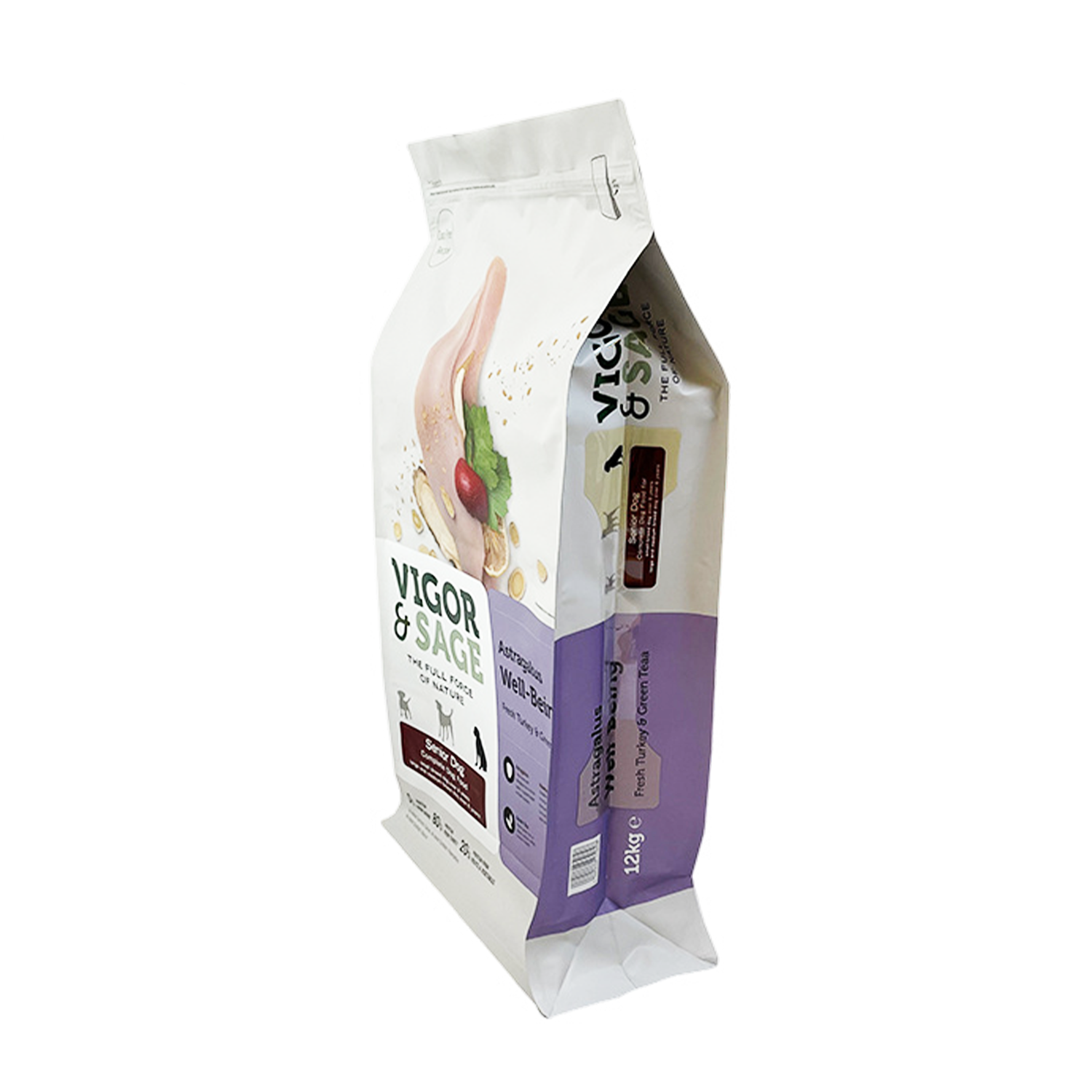
Scaling a flexible package to hold massive volumes drastically alters the physical dynamics of the container. Analyzing the physics of 6–10 kg Flat Bottom Bags reveals intense localized stress points. The gravitational force exerted by heavy volumes severely impacts the bottom gusset seals and the vertical side seams. During lifting, pallet stacking, and transit vibration, the kinetic energy of the dense product shifts continuously. If the material gauge is inadequate, this shifting mass creates hydraulic-like pressure against the lower seals. This leads to immediate seam splitting or gusset blowouts.
When a 10 kg bag of dog food is dropped from a tailgate, the internal pressure spikes massively. The bottom seals take the brunt of this force. A standard 4.0 mil film will stretch and snap at the seal transition points. You need a thicker gauge to distribute that kinetic energy across the polymer chains without reaching the yield point.
Standard retail thicknesses are entirely insufficient for bulk applications. High-capacity 6–10 kg formats strictly require multi-ply laminations exceeding 130 microns (approximately 5.1 mil). In many industrial scenarios, thicknesses push toward 150 to 180 microns (6.0 to 7.0 mil). This dense gauge is mandatory to prevent bottom-out failures, where the base of the bag detaches under the sheer weight of the contents. The increased micron rating ensures the structural integrity of the polymer chains remains intact even when subjected to sudden drops or rough warehouse handling.
Thickness alone cannot support a 10 kg load. The architectural design of the bag must work in tandem with the heavy-gauge material. High-capacity bags must feature quad-seal reinforcement, where all four vertical corners are welded to provide a rigid, box-like skeleton. Reinforced side-gussets and specialized bottom configurations—such as K-seals or V-seals—are necessary to distribute the load evenly across the entire base. These complex seal patterns prevent the weight from concentrating on a single focal point, reducing the risk of localized material fatigue.
Transporting 6–10 kg of product requires ergonomic handling solutions. Adding punch-out handles or heavy-duty patch handles to bulk bags introduces new vulnerabilities. When a consumer lifts a 10 kg bag by a top handle, the entire weight of the package is suspended from a few square inches of material. This requires severe localized thickness reinforcement. Manufacturers integrate secondary patch layers, bringing the thickness up to 8.0+ mil strictly around the handle area. Without this targeted reinforcement, the upward pulling force will easily tear through the standard film gauge, causing the bag to drop and rupture.
A standard 4.0 mil bag is rarely a single sheet of plastic. It is a highly engineered composite structure. Understanding this construction is vital for specifying the right materials. The outer layer is typically Polyethylene Terephthalate (PET), chosen for its high heat resistance and excellent printability. The middle layer serves as the barrier, utilizing Aluminum Foil (AL), Vacuum Metallized PET (VMPET), or Biaxially Oriented Polyamide (BOPA/Nylon) to block oxygen and UV light. The innermost layer is usually a thick gauge of Polyethylene (PE), which provides the structural bulk and acts as the heat sealant. The combined thickness of these distinct layers creates the final mil rating, with the PE layer usually accounting for the majority of the physical volume.
When troubleshooting a leaking bag, operators often blame the total thickness. Usually, the issue is the ratio of the layers. If a 4.0 mil bag has a 0.5 mil PET layer, a 0.5 mil foil layer, and a 3.0 mil PE layer, it seals well. If the supplier changes the ratio to 1.0 mil PET and 2.0 mil PE to save money, the total thickness remains 4.0 mil, but the seal strength drops drastically. The PE layer lacks the mass to flow and fill gaps around gusset folds.
Integrating natural Kraft paper into the laminate structure significantly alters both the perceived and actual thickness of the bag. Kraft paper adds immediate rigidity, tactile bulk, and an organic aesthetic. Paper is porous and lacks inherent sealing properties. To utilize Kraft paper effectively, it must be laminated to a thicker inner poly-layer. This inner polymer layer must be robust enough to maintain seal integrity and prevent the paper from absorbing moisture and delaminating. Paper-laminated bags often require a higher overall thickness to achieve the same functional durability as purely synthetic structures.
The packaging industry is rapidly shifting toward sustainable, mono-material structures, primarily utilizing all-PE (Polyethylene) or all-PP (Polypropylene) laminates. These recyclable bags offer environmental benefits but present unique structural challenges. Traditional mixed-polymer laminates rely on the stiffness of PET and the strength of Nylon to maintain shape. Mono-materials lack these rigid outer layers. To compensate for this loss of inherent stiffness and to achieve comparable barrier performance, mono-material flat bottom bags often require a 10% to 20% increase in overall thickness. A recyclable bag might need to be 5.0 mil to perform identically to a 4.0 mil traditional mixed-material bag.
Thickness can be achieved through different manufacturing processes, heavily influencing the bag's durability profile. Co-extruded films are created by melting multiple polymer streams together in a single pass, creating a unified, multi-layer film. Laminated films are individual webs bonded together using adhesives. At the exact same nominal thickness, laminated films generally offer superior puncture resistance and stiffness due to the added structural reinforcement of the adhesive layers and the distinct orientation of the individual webs. Co-extruded films may require a slightly thicker gauge to match the rigid, stand-up qualities of a heavily laminated structure.
Increasing the thickness of your packaging material has a compounding impact on supply chain logistics. Adding just 1.0 mil of thickness across an order of 100,000 bags drastically increases the total volume of raw plastic. This translates directly into heavier pallet weights and increased shipping costs. Thicker bags do not compress as tightly in corrugated master cartons. This increases the warehouse space required to store empty packaging inventory. Supply chain managers must calculate these secondary logistical costs when deciding to upgrade material thickness.
Automated fill-and-seal lines are highly sensitive to material gauge variations. Thicker bags require significantly higher heat to penetrate the outer layers and melt the inner sealant web. To achieve a hermetic seal on a 5.0 mil bag, the sealing jaws must operate at higher temperatures and clamp down for longer dwell times compared to a 3.0 mil bag. This increased dwell time slows down the entire packaging line, reducing the units-per-minute (UPM) throughput. Upgrading thickness without auditing equipment capabilities can lead to severe production bottlenecks and weak, superficial seals.
Check your current sealing jaw maximum temperature ratings.
Verify the pneumatic pressure available to the sealing cylinders.
Run a small batch of thicker material to test dwell time impact on UPM.
Inspect the seals for channel leaks using a vacuum chamber.
Advancements in polymer chemistry offer solutions to mitigate the need for excessive thickness. The choice of sealant resins plays a critical role in bag performance. Utilizing advanced metallocene Linear Low-Density Polyethylene (mLLDPE) for the inner layer provides exceptional seal strength, superior hot-tack properties, and high puncture resistance at a lower gauge. By upgrading the chemical quality of the sealant layer, brands can often reduce the overall bag thickness by 0.5 mil without sacrificing structural integrity or seal reliability, thereby offsetting raw material costs.
Determining the optimal thickness requires a calculated risk assessment comparing upfront costs against potential losses. Moving from a 3.5 mil to a 4.5 mil structure increases the per-unit cost of the empty bag. This marginal cost increase must be weighed against the financial devastation of in-transit ruptures. A 2% failure rate due to under-specified packaging results in lost product, damaged retail relationships, and expensive cleanup logistics. Calculating the return on investment (ROI) of thicker bags involves proving that the slight increase in packaging spend effectively eliminates the massive costs associated with product spoilage and returns.
A common pitfall in packaging design is the assumption that thicker is universally better. Excessively thick bags introduce new failure modes. When material becomes too rigid, it loses the flexibility required to absorb shock. This inflexibility leads to flex-cracking and "pinholing," particularly at the sharp folds of the bottom gusset. Instead of yielding to pressure, over-engineered, brittle materials simply snap or crack. Selecting the right thickness means finding the exact threshold where the bag is strong enough to contain the product but flexible enough to survive transit vibration.
Flexible packaging manufacturing is subject to mechanical tolerances. The thickness of a plastic film is rarely absolute across the entire web. Manufacturing tolerances can vary by ±10%. A bag specified at 4.0 mil nominal thickness might actually measure anywhere from 3.6 mil to 4.4 mil depending on the supplier's extrusion precision. Buyers must understand this variance and specify a minimum acceptable thickness in their supplier contracts to ensure the thinnest sections of the bag still meet the required performance thresholds.
Theoretical thickness specifications must be subjected to brutal physical testing before full-scale commercial procurement. Relying solely on data sheets is a massive operational risk. Implement standardized validation protocols using the actual product and the exact proposed material gauge.
ASTM D5276: Standard Test Method for Drop Test of Loaded Containers. This verifies the bag's ability to survive falls from specific heights without catastrophic seam failure.
ASTM F88: Standard Test Method for Seal Strength of Flexible Barrier Materials. This ensures the inner polymer layer is thick enough to fuse properly under standard machine settings.
ASTM F1140: Internal Burst Testing of Unrestrained Packages. This measures the overall tensile strength of the material when subjected to rapid internal pressurization.
Request unprinted material samples at varying thicknesses (3.5, 4.0, and 5.0 mil) to evaluate tactile rigidity and shelf presence.
Conduct internal drop tests utilizing the actual product to identify potential gusset or seal vulnerabilities before placing a full order.
Consult with a packaging engineer to verify machine compatibility and optimize your sealing jaw temperatures and dwell times for the new gauge.
Review supplier tolerance capabilities to ensure your minimum thickness requirements are consistently met during mass production runs.
A: Thickness is measured in mils (thousandths of an inch) or microns (thousandths of a millimeter). One mil equals 25.4 microns. Quality control teams use a highly calibrated digital micrometer to measure the total combined gauge of the multi-layer laminated structure at various points across the bag to ensure consistency.
A: Coffee packaging typically utilizes a 4.0 to 4.5 mil thickness range. This specific gauge provides enough structural rigidity for the bag to stand upright on shelves, offers excellent puncture resistance against hard roasted beans, and provides a stable base for integrating one-way degassing valves without warping the surrounding film.
A: No, raw thickness does not equate to barrier performance. Barrier properties depend entirely on the specific materials used in the laminate structure, such as EVOH, aluminum foil, or metalized polyester. A thin layer of foil blocks oxygen far more effectively than a very thick layer of standard structural polyethylene.
A: High-capacity bags holding 6 to 10 kg strictly require multi-layer laminates ranging from 5.0 to 6.0+ mil (130+ microns). This heavy-duty thickness is mandatory to support the massive product weight and must be paired with reinforced quad-seals and robust bottom gusset configurations to prevent seam blowouts.
A: It depends on your machinery's thermal capabilities. Thicker laminates require higher heat jaw temperatures, increased clamping pressure, and longer dwell times to melt the inner sealant layer. Standard impulse sealers used for thin films often fail to penetrate 5.0+ mil structures, resulting in weak, easily peelable seals.
A: Optimal thickness provides the mechanical stiffness necessary to support the product's downward gravitational force. If the material is too thin, the bottom gusset will bow outward or distort under the weight, causing the bag to lean, wobble, or completely fall over on the retail shelf.
A: Nominal thickness is the target specification, while actual thickness is the real-world measurement. Due to extrusion and lamination manufacturing tolerances, a bag with a nominal 4.0 mil specification might actually measure anywhere from 3.6 to 4.4 mil depending on the supplier's equipment precision.

