
Views: 0 Author: Site Editor Publish Time: 2026-08-06 Origin: Site


Pet food brands face a massive physical and logistical challenge when packaging large volumes of kibble. A 15 to 40-pound bag places immense stress on flexible packaging materials. If a bag fails during transit or handling, the result is immediate product loss, retailer chargebacks, and severe brand damage. Brands must constantly balance structural durability with strict barrier protection to prevent lipid oxidation in high-fat kibble. They also need to maintain premium shelf appeal without resorting to bulky, unmarketable formats. The industry-standard engineering solution to this complex problem is the quad seal bag. This specific pouch style balances high-capacity weight distribution with maximum retail visibility and supply chain efficiency. By reinforcing the corners and creating a stable base, brands can secure their product while optimizing their Custom Pet Food Packaging strategy.
Structural Integrity: Four reinforced corner seals distribute heavy product weight, significantly reducing the risk of side-seam blowouts and bottom-gusset tears during transit.
Maximized Branding Real Estate: The box-like structure provides five distinct, uninterrupted printable panels, allowing for comprehensive nutritional compliance labeling and premium brand messaging.
Self-Standing Shelf Stability: Excellent "standing ability" prevents slumping on retail shelves, ensuring a clean, box-like aesthetic even at high-volume weights.
Supply Chain Efficiency: The rigid, squared shape optimizes pallet stacking density and retail shelf space compared to traditional pillow bags.
Advanced Barrier Protection: Multi-layer, FDA-approved laminate compatibility ensures strict defense against moisture, oxygen, and pests, extending the shelf life of high-fat pet foods.
Packaging large pet food packs involves managing dynamic physical forces on the production floor and in the warehouse. Shifting kibble creates severe stress points on traditional packaging seams during palletization, stretch wrapping, and retail stocking. When a 30-pound bag drops off a conveyor or shifts during forklift transport, the kinetic energy transfers directly to the weakest points of the flexible material. Standard pouches often fail at the bottom gusset or the center back seal under this pressure. Engineering a bag to hold this weight requires a structural design that redirects stress away from the primary panels. We see failure rates spike when brands try to push standard pillow bags past the 15-pound mark. The material stretches, the seals creep, and eventually, the bag blows out. You need a package built like a structural column to handle the internal load and the external compression forces of stacked pallets.
Sealing all four vertical corners creates a rigid, box-like exoskeleton for the package. This design shifts the load-bearing stress away from the center panels and onto the reinforced edges. The four seals act like the pillars of a building. When the bag is filled with heavy kibble, the outward pressure pushes against these reinforced corners rather than stretching the flat film. This mechanical advantage drastically lowers the burst rate during drop tests and rough handling. It allows quad seal bags to handle capacities that would destroy standard flexible packaging. On the converting line, the heat seal jaws apply precise pressure and temperature to weld these corners, typically creating a 5mm to 10mm seal width. This continuous weld from top to bottom prevents the film from bowing outward. The structural rigidity means the bag holds its shape even when stacked five layers high on a pallet.
The expansion of the side gussets, combined with bottom seal reinforcement, creates a stable, flat base. This base provides independent standing ability without tipping or sagging. Unlike standard pouches that rely on the product weight to push a bottom gusset open unevenly, the quad seal structure forces the base into a uniform rectangular footprint. The center of gravity remains low and centered. This physical stability ensures the bag remains upright on retail shelves, presenting a clean, premium billboard to the consumer. In a retail environment, a bag that slumps looks cheap and damages brand perception. The folded bottom termination of a quad seal bag locks the gussets in place. When the kibble fills the void, it packs down tightly into the squared corners, creating a solid foundation. This prevents the "elephant foot" effect common in poorly designed bottom-gusset pouches.
Heavy, sharp kibble requires high tensile strength and puncture resistance. Manufacturers achieve this through multi-layer laminates, typically combining PET, VMPET, and PE layers. The outer PET layer provides printability and heat resistance against the sealing jaws. The middle metallized layer acts as a strict barrier against oxygen and moisture. The inner PE layer offers strong heat-seal characteristics and flexibility. Film thickness usually ranges from 100 to 150 microns depending on the target weight. All inner contact layers must utilize FDA-approved, food-grade materials. This compliance prevents chemical migration into the kibble and safeguards pet health over long shelf lives. We run migration tests to ensure no volatile organic compounds transfer from the adhesives or inks into the high-fat pet food. The laminate structure must also withstand the abrasive nature of extruded kibble during the filling process.
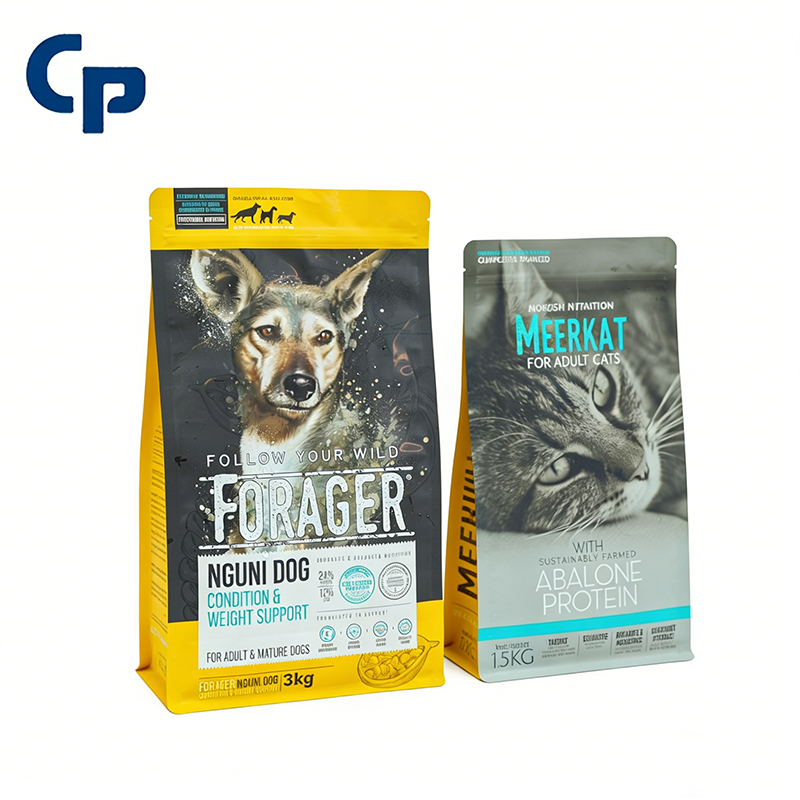
Pillow bags offer a cost-effective solution for small trial sizes or treats. However, they fail in large formats due to severe slumping and poor shelf presentation. A heavy pillow bag cannot stand upright; it must lie flat, destroying its retail visibility. Furthermore, pillow bags feature a single back seam and top/bottom seals. Under the pressure of 20 pounds of kibble, that center back seam becomes a critical failure point. The quad seal format eliminates the center back seam entirely, offering vastly superior rupture resistance and upright shelf display. When running pillow bags on a vertical form-fill-seal machine, the forming tube dictates the shape. For large volumes, the tube becomes impractically large, and the resulting bag is unwieldy. Quad seal tooling folds the gussets inward, creating a compact, dense package that maximizes internal volume without expanding the external footprint.
Standard bottom-gusset stand-up pouches work perfectly for weights under 5 pounds. When scaling past 10 pounds, traditional SUPs suffer from a severe bulging effect. The heavy product forces the bottom gusset to over-expand, causing the bag to lean forward or backward. This bulging compromises the aesthetic and makes the bags difficult to stack on pallets. The four-corner reinforcement of the quad seal design prevents this outward bulging, maintaining a crisp, rectangular profile regardless of the fill weight. A standard SUP relies entirely on the bottom seal for stability. If the product settles unevenly, the bag falls over. The quad seal design distributes the settling product evenly across the squared base. This predictability is essential for automated case packing and palletizing operations, where irregular bag shapes cause machine jams and pallet instability.
Flat bottom pouches, or box pouches, offer a completely flat base and excellent shelf stability. However, they involve higher manufacturing complexity and tooling costs. Flat bottom bags require specialized converting equipment to fold and seal the distinct bottom panel. Quad seal bags often present a more cost-effective yet structurally comparable solution. They utilize continuous side gussets sealed at the bottom, providing similar internal volume utilization and standing ability without the extreme premium of flat bottom pouch manufacturing. The web tension control required to register and seal a separate bottom web on a box pouch machine slows down production speeds. Quad seal bags can be formed from a single web of film, simplifying the converting process and reducing setup waste. For brands looking to balance premium presentation with operational efficiency, the quad seal format hits the sweet spot.
Packaging Format | Weight Capacity | Shelf Stability | Branding Panels | Structural Risk |
|---|---|---|---|---|
Quad Seal Bag | Excellent (15-40+ lbs) | High (Self-standing) | 5 Panels | Low (Reinforced corners) |
Pillow Pouch | Low (Under 5 lbs) | Poor (Lays flat) | 2 Panels | High (Center seam stress) |
Stand-Up Pouch | Medium (Up to 10 lbs) | Moderate (Bulges at high weights) | 2 Panels + Bottom | Medium (Bottom gusset stress) |
Flat Bottom Pouch | Excellent (15-40+ lbs) | Very High (Completely flat base) | 5 Panels | Low (Complex bottom seal) |
High-fat pet foods are highly susceptible to rancidity if exposed to oxygen and light. Quad seal structures perfectly accommodate the high-barrier films necessary to prevent fat oxidation, moisture ingress, and aroma loss. The multi-layer co-extruded films preserve palatability, ensuring the kibble smells and tastes fresh when the consumer opens the bag. The rigid corners also prevent micro-punctures from sharp kibble during transit, maintaining the integrity of the internal barrier layers. We measure barrier performance using oxygen transmission rate and water vapor transmission rate. A premium pet food requires an oxygen transmission rate of less than 1 cc/m2/day. The thick laminates used in these bags easily achieve these metrics. Furthermore, the structural integrity of the four corner seals prevents flex-cracking in the metallized layers, a common issue in standard pouches that compromises the barrier over time.
The marketing advantage of the five-panel billboard is substantial. Brands can utilize the front, back, two side gussets, and bottom for distinct messaging. Side-gusset printing ensures brand visibility even when heavy bags are stacked flat or horizontally on lower retail shelves. Consumers walking down the aisle can easily identify the brand, flavor, and nutritional benefits from multiple angles. This comprehensive printable area is a major driver for upgrading Custom Pet Food Packaging. Flexographic and rotogravure printing technologies allow for high-definition graphics across all panels. Because the bag holds its shape, the graphics do not distort or hide in folds. You can place mandatory nutritional information and barcodes on the back or bottom, leaving the front and side panels entirely dedicated to high-impact branding and product photography.
Logistical efficiency directly impacts the bottom line. The squared-off footprint of these bags eliminates dead space in shipping cartons. It allows for higher stacking density on pallets compared to bulging stand-up pouches or irregular pillow bags. This optimized geometry directly reduces freight costs by allowing more product per truckload. Furthermore, the stable, interlocking nature of stacked quad seal bags minimizes shifting during transit, drastically reducing shipping damage and product loss. When configuring a pallet layout, the predictable dimensions of a quad seal bag allow engineers to maximize the pallet cube. You can fit more pounds of product onto a standard 40x48 inch pallet without overhang. This efficiency cascades through the supply chain, reducing warehouse storage requirements and lowering the carbon footprint associated with transportation.
Modern consumers demand convenience, even with heavy bulk purchases. Manufacturers can integrate heavy-duty side gusset handles, allowing buyers to easily lift 30-pound bags off the shelf and into their cars. Slider zippers and press-to-close seals can be added to the top opening without compromising the bag's overall structural integrity. These features keep the product fresh after opening and prevent pest infestations in the consumer's pantry or garage. Applying a zipper to a quad seal bag requires specialized cross-web application equipment during the converting process. The zipper must be terminated cleanly at the side gussets to prevent air leaks. We also frequently integrate one-way degassing valves for specific formulations, allowing trapped air to escape during palletization without letting oxygen back into the bag. These functional additions elevate the user experience and drive repeat purchases.
Transitioning to this format involves higher per-unit costs compared to basic pillow pouches. The cost drivers include complex folding and sealing processes during conversion. The machinery must precisely align and seal four independent corners while managing thick, multi-layer laminates. These thicker laminates, necessary for puncture resistance, also increase raw material expenditures. Brands must account for these upfront manufacturing premiums when planning their packaging budgets. Changeover times on converting machines are longer for quad seal bags due to the precise alignment required for the gusset tuckers and corner seal jaws. Setup waste is typically higher until the web tracks perfectly. However, working with an experienced converter minimizes these inefficiencies. You are paying for structural engineering, not just printed film.
The rigid, premium appearance of the final package justifies higher retail price points. Consumers associate the structured, box-like aesthetic with high-quality, specialized, or grain-free pet food lines. The perceived value of the product increases alongside the quality of the packaging. Brands can often offset the higher per-unit packaging cost by positioning the product in a premium tier, capturing better margins on the retail shelf. When a consumer sees a perfectly squared bag with high-definition graphics standing tall next to a slumped, wrinkled pillow bag, they instinctively trust the product inside the structured bag more. This psychological advantage allows brands to command a 10% to 20% price premium, which more than covers the incremental cost of the upgraded packaging format.
The initial packaging premium is frequently recovered over the product lifecycle through supply chain savings. Reduced damage rates mean less shrinkage and fewer retailer chargebacks. Optimized freight density lowers transportation costs per pound of product shipped. When you calculate the reduction in wasted product and the efficiency gained in warehouse storage, the total lifecycle cost of Quad Seal Bags proves highly competitive for large-format items. A 2% reduction in unsalable product due to packaging failures can translate to hundreds of thousands of dollars in savings annually for a mid-sized brand. Furthermore, the ability to fit more product on a truck reduces the number of shipments required, directly lowering freight expenditures in an era of volatile transportation costs.
Transitioning packaging formats requires a thorough audit of operational realities. Brands must determine if their current filling lines can handle the new bags. High-volume operations often require specific form-fill-seal machinery capable of forming the four corner seals inline. Alternatively, brands can purchase pre-made pouches, which require specialized pre-made pouch filling lines with heavy-duty grippers to support the weight during the fill cycle. Retrofitting existing equipment involves significant capital expenditure. If you run pre-made bags, your rotary or inline filler must have grippers strong enough to hold a 30-pound bag by the top seal area without slipping. The duckbill spouts must open the bag completely to prevent product bridging during the high-speed drop. Failure to match the bag specifications to the filling equipment results in massive downtime and product spillage.
Automated filling at high speeds introduces the risk of seal failures, particularly at the gusset transition points where multiple layers of film overlap. If the heat-seal calibration is slightly off, these thick transition points can leak or burst. Mitigation strategies are essential. Facilities must implement rigorous burst testing, vacuum leak detection, and precise heat-seal calibration protocols. Consistent monitoring ensures the seals maintain their integrity under the stress of 30+ pounds of product. We recommend pulling samples every 30 minutes for destructive testing. Operators place the sealed bags in a vacuum chamber submerged in water to check for micro-leaks at the gusset folds. Drop tests from a height of 3 to 4 feet simulate warehouse handling. If the bag fails, the line stops, and the seal jaw temperatures and dwell times are adjusted immediately.
The pet food industry faces a significant challenge in sourcing mono-material, recyclable quad seal bags that still meet strict puncture and weight requirements. Traditional multi-layer laminates are notoriously difficult to recycle. While new machine direction oriented polyethylene structures offer recyclability, they often lack the extreme heat resistance and rigidity of traditional laminates. Brands must carefully evaluate the trade-offs between utilizing eco-friendly materials and maintaining the structural reliability required for heavy pet food. Running mono-material structures on high-speed lines requires precise temperature control. Polyethylene has a narrower sealing window than traditional laminates. If the jaws are too hot, the film melts and sticks; if too cold, the seal fails. Advancements in barrier coatings applied to recyclable films are bridging the gap, providing the necessary oxygen barrier while remaining compatible with the recycling stream.
Quad seal bags remain the most reliable and commercially viable format for large-scale, premium pet food packaging. They solve the critical physical challenges of weight distribution while providing an exceptional canvas for brand marketing. The structural integrity prevents costly transit damage, and the self-standing nature dominates retail shelf presence. Upgrading to this format requires careful consideration of material specifications, filling line capabilities, and supply chain logistics, but the return on investment in brand perception and reduced product loss is undeniable.
Audit your current SKU weights and failure rates; target products exceeding 10 pounds for immediate format upgrades.
Request detailed material specification sheets from your converter to verify transmission metrics align with your kibble's fat content.
Conduct physical drop-testing and transit simulations with actual product weights before committing to a full production run.
Evaluate your facility's filling equipment capabilities to determine the capital expenditure required for pre-made pouch grippers or form-fill-seal tooling.
A: These bags comfortably hold between 15 to 40 pounds of product. The exact capacity depends on the thickness of the multi-layer laminate and the width of the corner seals. Custom engineering and thicker film gauges can push this capacity higher for specialized bulk applications without compromising structural integrity.
A: Their rigid, rectangular shape eliminates bulging and dead space. This allows bags to stack flat and tightly against each other, maximizing the number of units per pallet. This density reduces freight costs, optimizes warehouse storage, and minimizes load shifting during transit.
A: Yes, but with limitations. Mono-material structures are available for recycling, but they require precise heat-seal control and may sacrifice some rigidity. Compostable options currently struggle to hold heavy weights and maintain long-term oxygen barriers required for high-fat pet foods.
A: A flat bottom pouch has a completely separate, flat bottom panel sealed to the side and front panels, requiring complex tooling. A quad seal bag uses continuous side gussets that are folded and sealed shut at the bottom, offering a more cost-effective manufacturing process.
A: Yes. If using rollstock, you need a vertical form-fill-seal machine equipped with a specific quad seal forming assembly. If using pre-made bags, your filling line needs heavy-duty grippers capable of supporting the bag's weight during the high-speed fill cycle.
A: Absolutely. The multi-layer construction easily incorporates high-barrier films. These layers block oxygen and moisture transmission, preventing fat oxidation, preserving aroma, and keeping semi-moist foods from drying out over a long shelf life.
A: Reputable packaging manufacturers use strict food-grade, FDA-approved materials for all inner contact layers. This ensures no harmful chemicals or volatile organic compounds migrate from the packaging into the pet food, maintaining safety and compliance.

