
Views: 0 Author: Site Editor Publish Time: 2026-08-06 Origin: Site


Packaging procurement requires brands to balance premium shelf appeal, material efficiency, and stringent sustainability mandates. The ongoing shift in consumer preferences forces companies to rethink how they present products on retail shelves. You must deliver visual impact while minimizing environmental footprints and maintaining operational efficiency on the filling line.
Packaging engineers and brand managers face a specific challenge when evaluating new formats. You must justify the higher unit cost of flat bottom bags against alternative formats like standard stand-up pouches or rigid containers. This requires ensuring product protection, extending shelf life, and verifying operational compatibility with existing filling equipment. The structural advantages of a five-panel design often look great in a prototype, but they must translate into measurable supply chain and retail performance.
Analyzing the primary demand drivers within the flat bottom bag market provides a data-backed framework for making this decision. By examining how different sectors utilize this format, you can evaluate whether it aligns with your specific product lines, operational capabilities, and return on investment targets.
Market Drivers: The flat bottom bag market is accelerating due to demands for shelf stability, maximized internal volume, and environmentally friendly material transitions.
Market Scale: Food packaging is the dominant driver, projected to grow from USD 1.5 Billion in 2024 to USD 2.8 Billion by 2035.
Primary Applications: Human food and pet consumables dominate demand, requiring strict adherence to barrier and compliance standards.
Structural Advantage: Five panels of printable real estate offer superior branding opportunities, offsetting higher initial tooling and unit costs.
Implementation Reality: Successful adoption requires auditing existing filling lines, as flat bottom formats often require specific automated filling and sealing equipment.
A successful packaging transition depends on clearly defined success criteria. You must look beyond basic aesthetics to measure improvements in the product-to-package ratio. Success often means reduced logistics costs, increased shelf visibility, and a measurable drop in material waste. When evaluating a shift to flat bottom bags, these metrics provide the foundation for approval. You need hard data to show that the structural change yields operational savings that offset the initial material investment.
The macroeconomic health of the flat bottom bag market shows strong upward momentum. The dominant food packaging segment is projected to grow from USD 1.5 Billion in 2024 to USD 2.8 Billion by 2035. This trajectory reflects a broader industry shift toward flexible formats that offer rigid-like stability. Consumer demand for environmentally friendly packaging solutions continuously steers investment toward green materials, pushing manufacturers to innovate with recyclable and compostable laminates. Brands that fail to adapt to these material expectations risk losing market share to competitors who prioritize sustainable packaging.
Sustainability and material efficiency represent core advantages of this format. Flat bottom bags use up to 30% less material than rigid alternatives while holding the exact same volume. This reduction directly appeals to eco-conscious procurement mandates and helps brands hit aggressive corporate sustainability targets. Less plastic by weight translates directly into a reduced carbon footprint during the manufacturing phase. Furthermore, the reduction in source material lowers the extended producer responsibility (EPR) fees that many regions now impose on consumer goods companies.
The logistics and supply chain impacts further strengthen the business case. Shipping flat, unfilled bags requires a fraction of the space needed for rigid containers. This freight advantage significantly reduces the warehousing footprint and lowers transportation emissions. You can fit thousands of flexible bags on a single pallet, drastically cutting the number of inbound freight trucks required to supply your filling facilities. This density advantage extends to outbound logistics as well, allowing more finished product to fit into standard shipping cartons.
Packaging Type | Inbound Freight Density (Units per Pallet) | Material Weight per 500g Volume | Warehousing Space Requirement |
|---|---|---|---|
Flat Bottom Bag (Flexible) | 15,000 - 20,000 | 12g - 18g | Minimal (Ships Flat) |
Rigid Plastic Tub | 1,500 - 2,500 | 45g - 60g | High (Ships Formed) |
Glass Jar | 1,000 - 1,800 | 250g - 350g | Very High (Ships Formed) |
The coffee and tea sector relies heavily on the structural and functional benefits of Food Grade Flat Bottom Bags. Freshly roasted coffee releases carbon dioxide, making one-way degassing valves an absolute necessity. These valves allow gas to escape without letting oxygen in, preventing the bag from bursting while maintaining freshness. High-barrier requirements are equally critical. Structures utilizing aluminum foil or metalized PET prevent oxygen and moisture ingress, preserving the delicate flavor profiles of premium roasts. Without these specific barrier layers, coffee stales rapidly, leading to unacceptable consumer experiences.
Snacks, confectionery, and dry foods represent another massive demand segment. Resealability plays a major role in extending consumer shelf life after the initial opening. Pocket zippers and standard press-to-close mechanisms keep products fresh in the pantry. The structural benefit of the flat bottom prevents tip-overs on retail shelves. This stability ensures the brand message remains front-facing, capturing consumer attention more effectively than sagging pillow pouches. Retailers prefer this format because it simplifies shelf stocking and maintains a clean, organized display.
Evaluating food applications requires strict attention to compliance and material science. You must ensure all packaging meets FDA, EFSA, and GFSI compliance requirements for direct food contact. Mapping specific barrier layers to expected outcomes is crucial. For example, integrating EVOH layers provides exceptional oxygen resistance, while AL (aluminum) offers the ultimate barrier against light and moisture, directly correlating to specific shelf-life extensions. You must match the material specification to the exact degradation triggers of your food product.
Identify the primary degradation factors for your specific food product (e.g., moisture, oxygen, UV light).
Select the appropriate barrier materials (EVOH, AL, metalized PET) to counteract those specific factors.
Verify that all selected laminates and adhesives hold current FDA or EFSA food contact certifications.
Conduct accelerated shelf-life testing to validate the barrier performance under simulated retail conditions.
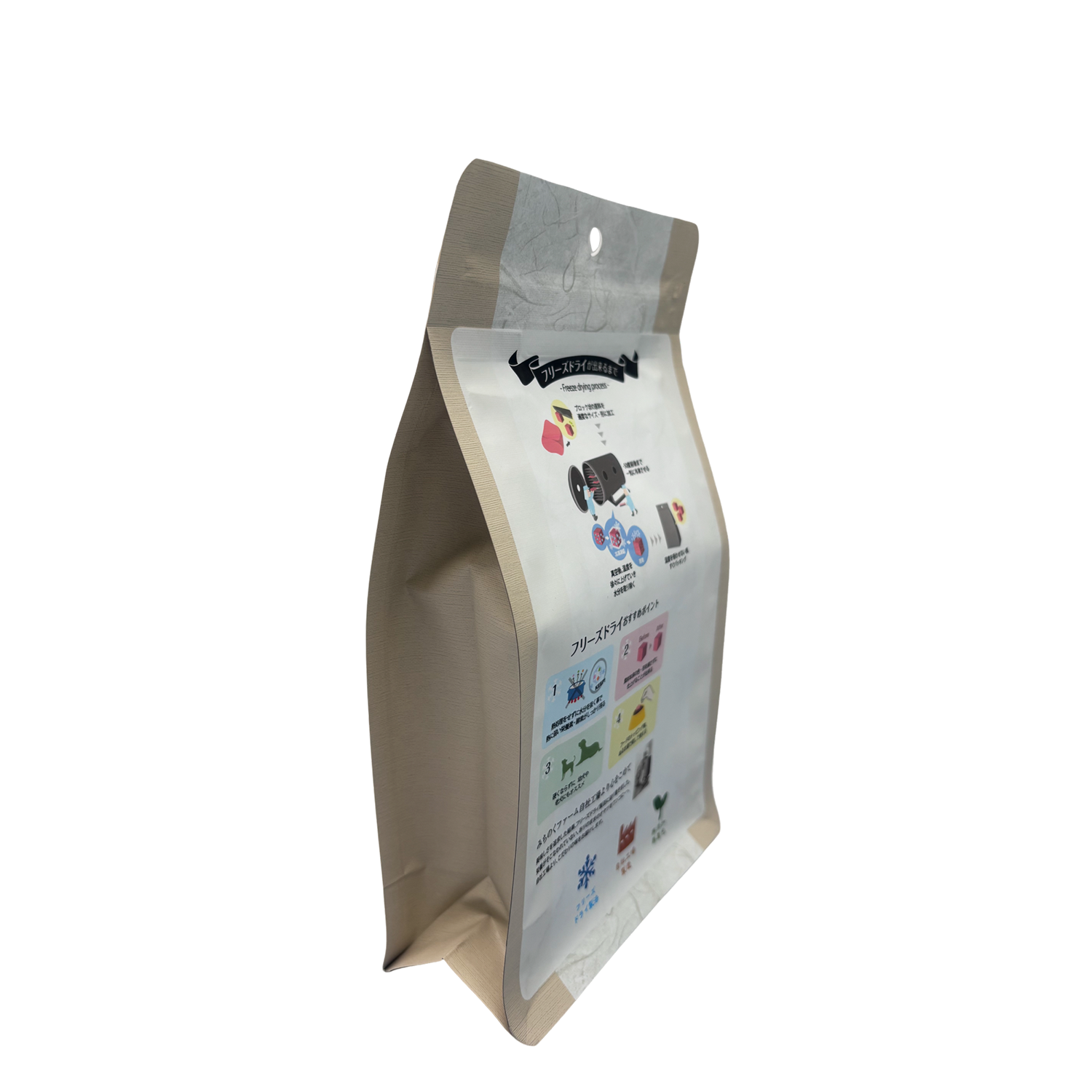
The pet care industry demands packaging that can handle significant weight and volume. The flat bottom design is critical for heavy products, particularly 5lb to 20lb kibble bags. Side gussets and a completely flat base distribute weight evenly across the footprint. This structural integrity prevents seam bursts during transit and rough handling, ensuring the product arrives intact from the warehouse to the consumer's home. Standard bottom-gusset pouches simply cannot support this much weight without tipping or tearing at the seal junctions.
Premiumization in pet care drives the aesthetic requirements of Custom Pet Food Packaging. As consumers shift toward human-grade pet food, brands must signal premium quality through their packaging. Utilizing matte finishes, spot UV treatments, and clear windows allows brands to differentiate themselves on crowded shelves. The five-panel design provides ample space for nutritional information, brand storytelling, and high-resolution graphics. This real estate is essential for communicating the complex ingredient profiles and health benefits that modern pet owners demand.
Implementing flexible packaging in the pet food sector comes with specific risks. The primary concern is the risk of puncture from sharp kibble or hard treats. You must specify required puncture-resistant laminate structures to mitigate this risk. Nylon and PE blends are standard choices for high-puncture applications. Conducting rigorous drop-test standards ensures the chosen material matrix can withstand the physical realities of the retail supply chain. A bag that fails a standard three-foot drop test is a liability in a warehouse environment.
Beyond food and pet care, luxury retail and non-food boutiques utilize flat bottom structures for premium branding. The format has a rich historical legacy, evolving from Margaret Knight’s groundbreaking invention of the flat-bottom paper bag machine. Today, modern, high-speed automated paper bag making solutions produce millions of units daily. Luxury brands use heavyweight paper flat bottom bags to deliver a high-end boutique experience, relying on the sturdy base and crisp edges to convey quality. The tactile feel of heavy kraft paper combined with foil stamping creates a memorable unboxing experience.
The production methods vary significantly depending on the end-use. Fully automated paper production dominates the retail takeaway and grocery sectors due to its speed and cost-effectiveness. In contrast, laminated polymer options serve applications requiring moisture barriers or extended durability. You must align the material choice with the specific environmental conditions the bag will face after leaving the store. A paper bag works for dry retail goods, but a laminated structure is necessary for anything that might encounter moisture or require long-term storage.
Agricultural and chemical products also generate growing demand for flat bottom bags. Lawn care items, fertilizers, and powdered chemicals benefit from the stability and volume efficiency of the format. However, these applications require specialized material engineering. You must incorporate chemical-resistant inner layers to prevent degradation of the packaging. Additionally, integrating child-resistant closure systems is often a regulatory requirement for hazardous agricultural or household chemicals. These specialized zippers require specific heat-sealing parameters to function correctly.
Transitioning to a new packaging format requires navigating several conceptual trade-offs. You must weigh the cost against the value delivered. Flat bottom bags generally have a higher cost-per-unit compared to standard stand-up pouches (Doypack) and rigid boxes. However, the increased branding space and premium perception often justify the expense for high-margin products. You have to calculate whether the anticipated increase in sales volume and shelf visibility offsets the higher packaging spend.
Aesthetics often clash with recyclability goals. Multi-layer high-barrier films provide excellent product protection but are notoriously hard to recycle. Conversely, emerging mono-material (PE/PE) structures offer recyclability but may require compromises in barrier performance or visual finish. Choosing between laminated polymer and paper solutions depends entirely on the application. Paper-based flat bottom structures work best for retail, takeaway, and dry grocery, while high-barrier plastic composites remain necessary for sensitive consumables.
Packaging Format | Shelf Stability | Branding Space | Relative Unit Cost | Best Application |
|---|---|---|---|---|
Flat Bottom Bag | Excellent | 5 Panels | High | Premium Coffee, Pet Food |
Stand-Up Pouch (Doypack) | Moderate | 2 Panels + Bottom | Medium | Snacks, Liquids |
Rigid Box | Excellent | 6 Panels | Very High | Luxury Goods, Fragile Items |
Scalability relies heavily on proper supplier selection. When auditing packaging suppliers, you must evaluate their certifications to ensure compliance with your industry standards. Consider the trade-offs between domestic and overseas production. Overseas suppliers may offer lower unit costs but require longer lead times and higher minimum order quantities. Domestic suppliers provide agility and faster turnarounds, which is crucial during product launches. You must balance these factors against your cash flow and inventory management capabilities.
Filling equipment compatibility represents the most significant implementation risk. Flat bottom bags often require specialized rotary or inline pouch-fill-seal machines. The side gussets create unique automation constraints, demanding specific grippers and opening mechanisms. If your legacy equipment cannot handle these mechanisms, you face a severe risk of bottlenecking on the production line. You must consult with your equipment manufacturer before committing to a flat bottom format to verify that your current machinery can open, fill, and seal the bags without excessive downtime.
Tooling and lead times also require careful planning. Custom cylinder costs for rotogravure printing require significant upfront investment, making it suitable only for high-volume runs. If you manage multiple SKUs or require frequent design changes, digital printing offers greater flexibility. While digital printing carries a higher unit cost, it eliminates cylinder fees and drastically reduces minimum order quantities, allowing for agile market testing. You should map out your projected volume across all SKUs to determine which printing method makes the most financial sense.
The flat bottom bag market is driven primarily by premium food and pet care sectors where shelf presence and volume efficiency justify the investment. While the unit cost is higher than standard pouches, the structural stability, reduced logistics footprint, and superior branding real estate deliver measurable returns for high-value products. Procurement teams should base their format decision on required barrier properties, filling line compatibility, and target profit margins.
Initiate a structural prototype phase to test stability and volume capacity with your actual product.
Request material data sheets (MDS) from suppliers to verify barrier properties and compliance certifications.
Conduct a pilot run on existing filling equipment to identify potential bottlenecks before commercialization.
Perform drop tests and transit simulations to ensure the selected material matrix prevents seam bursts.
A: Growth is driven by the format's ability to reduce material usage by up to 30% compared to rigid packaging. The market is expanding rapidly in food segments, scaling toward 2035. Brands favor the superior shelf stability and the five-panel branding advantage to capture consumer attention.
A: Manufacturers use multi-layer laminates including PET, AL, EVOH, and LLDPE to achieve high oxygen and moisture barriers. Emerging options include recyclable mono-materials (PE/PE) and traditional high-strength kraft papers for dry goods requiring less stringent barriers.
A: The flat bottom design provides excellent weight distribution, preventing tip-overs. The side gussets and flat base offer superior burst resistance for heavy volumes like 20lb kibble bags. Additionally, the five panels support premium aesthetic capabilities like matte finishes and spot UV.
A: Flat bottom bags feature side gussets and a completely flat base, creating a box-like shape. This offers more internal volume and better stability. Standard stand-up pouches (Doypacks) rely on a single bottom gusset and taper at the top, providing less branding space.
A: Yes. The side gussets require specific grippers and opening mechanisms on fill-and-seal lines. Legacy equipment designed for standard flat pouches often cannot open or seal flat bottom bags without significant modifications or bottlenecking.
A: Traditional mixed-material bags are not easily recyclable. However, newer mono-material PE/PE structures qualify for Store Drop-off recycling programs. Paper-based versions without heavy plastic laminations are generally curbside recyclable.

