
Views: 0 Author: Site Editor Publish Time: 2026-08-21 Origin: Site


In the highly regulated pet nutrition sector, selecting a supplier carries immense stakes. Packaging failure directly equates to compromised food safety, costly recalls, and catastrophic brand damage. Unfortunately, many brands over-index on aesthetics and marketing while under-auditing their partners. They frequently overlook the operational, regulatory, and material realities essential for reliable production. To protect product integrity and ensure scalable growth, brands must run a rigorous, evidence-based audit. You must evaluate potential suppliers across facility compliance, barrier engineering, and supply chain resilience. A thorough vetting process distinguishes genuine manufacturing partners from transactional vendors. It shields your business from unseen vulnerabilities. Readers will learn how to interrogate food safety certifications, assess advanced material science capabilities, and validate sustainability claims. You will also discover frameworks for mitigating supply chain risks and running effective production line trials.
Certifications are non-negotiable: Validating GFSI-recognized certifications (SQF, BRCGS) separates legitimate partners from high-risk vendors.
Material science dictates shelf life: Evaluating Oxygen (OTR) and Moisture (MVTR) barrier properties is critical for preventing lipid oxidation in high-fat kibble and treats.
Customization must align with operations: Custom Pet Packaging features (like specialized closures) must be tested against your facility's filling line speeds and equipment capabilities.
Scalability requires proof, not promises: Auditing a supplier’s raw material sourcing and surge capacity prevents stockouts during demand spikes.
Generic "food-grade" claims remain entirely insufficient without rigorous third-party validation. Regulatory scrutiny regarding pet food safety demands stringent human-grade production standards. Potential packaging partners must operate under strict hygiene protocols to prevent cross-contamination. You cannot assume a supplier follows these rules. You must verify their compliance through empirical evidence.
Start by verifying Global Food Safety Initiative (GFSI) recognized certifications. Certifications like SQF, BRCGS, and FSSC 22000 indicate robust safety cultures. However, simply holding a certificate tells an incomplete story. Request the supplier’s most recent third-party audit scores. Reviewing actual scores reveals whether they barely passed or demonstrated excellence. You should also evaluate their Hazard Analysis Critical Control Point (HACCP) plans. Strong HACCP plans proactively identify and neutralize chemical, physical, and biological risks during manufacturing.
Traceability protocols represent another crucial evaluation dimension. Ask potential partners a simple question. How quickly can they trace a specific film roll to a finished pouch? Leading suppliers use automated ERP systems to isolate affected batches within minutes. If a recall occurs, swift traceability minimizes financial impact.
A supplier’s willingness to share information indicates their overall reliability. Transparency builds trust. Warn your procurement team against vendors refusing to share Corrective Action Reports (CARs) from past audits. Every manufacturing facility experiences deviations. Excellent suppliers document these deviations, implement corrective actions, and share them openly. Secrecy often masks systemic operational failures.
The fundamental purpose of pet food packaging involves preserving nutritional integrity. A beautiful bag means nothing if the food spoils inside. The supplier must demonstrate deep expertise in material science explicitly tailored to your specific formula. They should recommend structures based on scientific barrier testing.
Different product formulations require entirely different material engineering strategies. You must consider these implementation realities:
High-Fat Formulas: Premium diets often contain high fat levels. They require advanced grease resistance and exceptional oxygen barriers. Low Oxygen Transmission Rates (OTR) prevent lipid oxidation. Oxidation causes rapid rancidity and degrades essential fatty acids.
Extruded Kibble: Hard, abrasive kibble demands high puncture and tear resistance. Suppliers often recommend durable PET/PE laminations. These robust structures prevent the kibble from piercing the bag during transit.
Moisture Control: Semi-moist treats need moisture retention, while dry kibble needs moisture exclusion. Low Moisture Vapor Transmission Rates (MVTR) prove critical. Poor MVTR leads to mold growth in treats or a stale, unappealing crunch in kibble.
Before accepting any physical samples, request comprehensive Technical Data Sheets (TDS) for all proposed structures. A TDS provides quantifiable OTR and MVTR metrics. Compare these figures against your target shelf-life requirements. Never rely on subjective promises regarding freshness.
Product Type | Primary Risk Factor | Critical Barrier Need | Common Material Solution |
|---|---|---|---|
High-Fat Kibble | Lipid Oxidation / Rancidity | Ultra-low OTR & Grease Resistance | PET / VMPET / PE |
Semi-Moist Treats | Mold Growth / Drying Out | Low MVTR | PET / AL / PE |
Large Breed Extruded | Bag Puncture / Tearing | High Tensile Strength | Heavy-duty Nylon / PE |
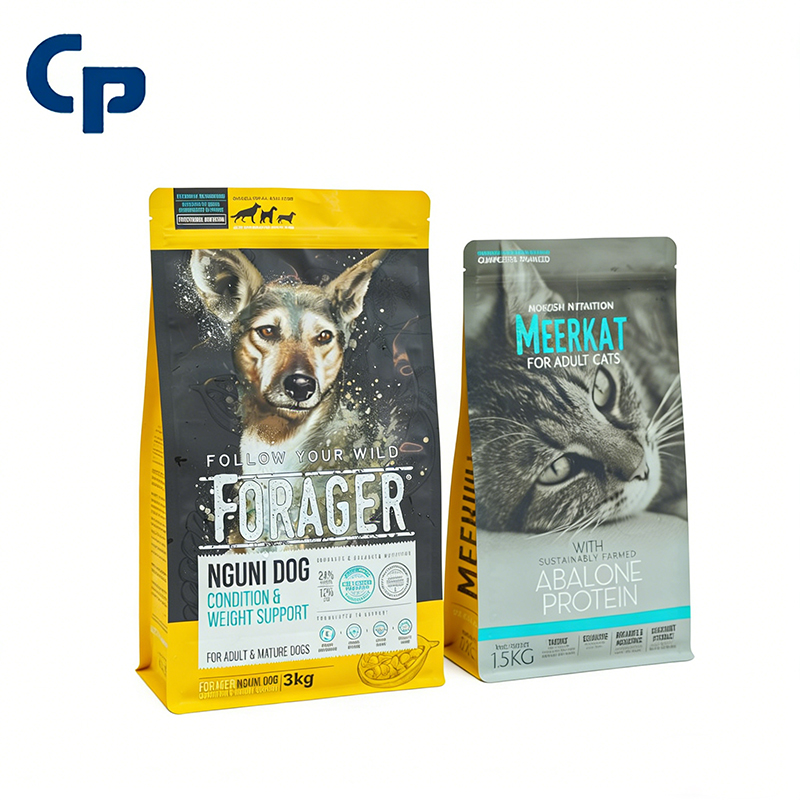
Many brands eventually move from stock pouches to proprietary structural designs. This transition helps capture market share and improves user experience. Custom Pet Packaging elevates your brand presence on crowded retail shelves. However, advanced customization introduces significant technical complexity. You must audit the supplier's print execution and functional portfolio.
Assess their print quality and consistency rigorously. Ask about their color-matching processes. Do they hold a G7 Master Printer certification? G7 certification ensures uniform color reproduction across multiple print runs. Furthermore, evaluate their registration capabilities across different print technologies. Whether they use Flexographic, Rotogravure, or Digital printing, the graphics must remain crisp. Misaligned text or muddy imagery destroys premium brand positioning.
Next, audit their functional features portfolio. Consumers demand convenience. A strong supplier offers various closures, including press-to-close zippers, hook-and-loop systems, and slider closures. They should also provide degassing valves for specific formulas and laser scoring for effortless opening.
Beware of over-engineering. Heavily customized packaging often fails on automated fill-and-seal lines. Thick zipper profiles might jam your equipment. A novel pouch shape might refuse to stand upright on the conveyor belt. The packaging supplier must coordinate directly with your co-packer or internal operations team. Open communication prevents costly production downtime.
Retailers and modern consumers actively demand eco-friendly options. However, greenwashing presents a massive liability for brands. Making unsubstantiated environmental claims invites regulatory fines and destroys consumer trust. You must thoroughly vet a supplier's sustainability narrative against operational realities.
Audit any claims of "recyclable" or "compostable" materials. Do not accept vague assertions. Require definitive proof of certifications. Look for How2Recycle pre-qualifications for recyclable structures. For compostable options, demand BPI (Biodegradable Products Institute) certification. These independent bodies verify environmental claims through rigorous testing.
Investigate the inevitable performance trade-offs. Sustainable materials behave differently than conventional plastics. Ask specific questions about mono-material structures. Do their recyclable PE/PE structures offer the identical barrier protection as traditional mixed-material laminates? Often, removing the metalized layer reduces the oxygen barrier. This reduction can significantly shorten your product's shelf life.
Maintain a highly skeptical lens during this evaluation phase. Advise your procurement team to ask for real-world case studies. Has the supplier conducted long-term shelf-life testing on these exact sustainable lines? Theoretical material performance rarely matches real-world warehouse conditions. You need concrete data proving the eco-friendly pouch will protect your formula for eighteen months.
A supplier offering excellent quality but volatile lead times will eventually choke your revenue. Stockouts damage retailer relationships and push loyal customers toward competitors. Evaluating a supplier's operational resilience is just as critical as evaluating their material science. You need a partner capable of absorbing market shocks.
Begin by discussing Minimum Order Quantities (MOQs). High MOQs tie up working capital. They also restrict your ability to launch niche SKUs or seasonal flavors. Ensure their MOQs align with your cash flow realities and overall SKU proliferation strategy.
Clearly differentiate between initial lead times and repeat order lead times. Initial orders always take longer. They include artwork approvals, cylinder engraving, and plate making. Repeat orders should arrive much faster. Lock down firm commitments for both timelines.
Examine their raw material sourcing strategy closely. A resilient supplier maintains strong contingency plans. Ask about their secondary suppliers.
Who supplies their base films, inks, and adhesives?
If their primary film supplier faces a catastrophic shortage, what is their immediate backup plan?
Do they hold safety stock of critical raw materials on site?
Consider geographic vulnerabilities. Overseas suppliers often offer highly attractive unit costs. Yet, domestic suppliers typically provide better agility and lower freight risk. Disruptions at major ports or sudden geopolitical shifts can delay overseas shipments for months. Weigh these logistical risks carefully when making your final selection.
Narrowing down a list of potential vendors to a single trusted partner requires objective decision logic. After conducting the initial audits, you should have roughly three strong candidates remaining. Moving into the procurement phase requires methodical, step-by-step validation.
First, execute a comprehensive Non-Disclosure Agreement (NDA). This protects your proprietary formulas and brand strategies. Once the NDA is signed, request a formal Request for Proposal (RFP). The RFP should outline your exact volume projections, barrier requirements, delivery schedules, and quality expectations.
Never commit to full-scale production without executing a line trial. This step remains absolutely non-negotiable. Request unprinted rollstock or sample pouches from the shortlisted suppliers. Run these samples through your specific filling equipment at full operational speed. Pilot runs expose hidden issues. You might discover the film lacks sufficient slip for the forming tube, or the seal requires too much dwell time.
Finally, establish robust Service Level Agreement (SLA) terms before signing the master contract. The SLA dictates the rules of engagement. It must define acceptable defect rates clearly. It should also outline on-time delivery percentages and specify financial recourse for severe packaging failures. A strong SLA protects your bottom line if the supplier underperforms.
Selecting a packaging supplier represents a strategic risk-management decision, not a simple procurement task. Brands must look beyond glossy marketing brochures and attractive price per unit metrics. A diligent audit framework protects your supply chain from costly disruptions and embarrassing product recalls.
By rigorously auditing safety compliance, you shield consumers from health hazards. By evaluating material science, you guarantee nutritional integrity and extended shelf life. Validating custom capabilities ensures smooth manufacturing line operations. Finally, examining supply chain robustness guarantees consistent product availability during aggressive growth phases.
Take proactive steps today to secure a partnership protecting your product. Reach out for a specialized consultation regarding your material needs. Request a comprehensive sample pack to test on your automated lines. Establish your baseline criteria, demand transparency, and build a resilient packaging supply chain.
A: The industry standard generally falls between 1% and 2% for flexible packaging. However, highly automated fill-and-seal lines often require stricter tolerances. Many premium brands negotiate SLAs demanding defect rates below 0.5% to prevent machine jamming and optimize overall equipment effectiveness.
A: Transitioning typically takes 8 to 12 weeks. This timeline accounts for structural engineering, artwork approval, color matching, and manufacturing printing plates. It also includes mandatory line trials on your specific filling equipment before full-scale commercial production begins.
A: While a few massive conglomerates offer both, most suppliers specialize. Flexible pouch extrusion and rigid plastic molding require entirely different manufacturing equipment and material science expertise. Brands should evaluate a supplier based on their core competency rather than forcing them out of their depth.

