
Views: 0 Author: Site Editor Publish Time: 2026-08-21 Origin: Site


High-protein, high-fat kibble formulations are driving rapid market growth today. However, they introduce a severe logistical challenge for manufacturers. The primary threats include aggressive grease migration and rapid fat oxidation. Brands often standardize on basic wrappers for these complex diets. This mistake quickly leads to delamination, rancidity, and mounting consumer complaints. Buyers frequently transfer ruined kibble to plastic bins at home. These secondary bins absorb fats and odors, multiplying bacterial risks over time. Compromised freshness heavily exposes companies to potential FDA compliance risks. To protect product integrity and brand reputation, selecting the right physical structure and multi-layer material is vital. It represents a critical bottom-of-funnel procurement decision for modern pet brands. You will discover exactly how specialized high-barrier films prevent grease penetration. We will evaluate dominant structural formats to identify the clear winner for premium formulations. You will also learn how to specify barrier layers to secure long-term consumer loyalty.
The core threat: Oily kibble requires specialized high-barrier films to prevent grease penetration and oxygen ingress, which standard single-layer plastics cannot handle.
The structural winner: Flat Bottom Bags offer the optimal combination of heavy-duty structural integrity, maximum branding real estate, and the ability to support thick, multi-layer barrier laminations.
Material matters most: Structural choices must be paired with specific EVOH or foil layers to maintain FDA-compliant storage standards and prevent fat oxidation.
Consumer retention: Resealability (e.g., press-to-close zippers, hook-and-loop) is non-negotiable for high-fat kibble to prevent premature spoilage after opening.
When oily kibble interacts with sub-par pet food packaging, the physical reactions prove disastrous. High-fat diets contain volatile oils. These liquids naturally seek to migrate outward through porous barriers. They seep easily through poorly designed polymer layers. This outward migration ruins external graphics quickly. It leaves a slippery, unappealing film on the bag exterior. Furthermore, it destroys overall structural integrity. The phenomenon causes severe multi-layer delamination. The chemical adhesive binding the plastic films dissolves upon contact with aggressive fats. It separates the sturdy bag into flimsy, unmanageable sheets.
Health and compliance risks also escalate rapidly. The FDA mandates strict storage guidelines regarding pet food oxidation and rancidity. Fat oxidation ruins kibble palatability in a matter of days. More importantly, feeding rancid fats can cause severe gastrointestinal distress in pets. Veterinarians frequently treat dogs suffering from vomiting caused by degraded fats. You risk severe regulatory scrutiny if poor barrier films compromise product safety.
Real-world consumer behavior reveals a troubling trend. Buyers frequently transfer premium food to secondary plastic containers at home. They do this because the original bag becomes dangerously greasy. Often, the flimsy top track simply will not seal. This habit erodes brand loyalty completely. It removes your branding from their daily view. It also exposes the kibble to harmful bacteria. Invisible pathogens often hide in unwashed plastic household bins.
Procurement teams must compare the three dominant formats for mid-to-large volume kibble. We will focus purely on their ability to handle dense, oily products. A weak structure compromises even the best barrier films.
Standard Stand-Up Pouches (Doyen) dominate the entry-level market.
Pros: They are highly cost-effective for small volumes. They run efficiently on basic filling lines.
Cons: They lack adequate stability for heavy weights. Their limited bottom gusset space restricts the thickness of multi-layer high-barrier films. These thick films are strictly required for true oil resistance. The base often warps under pressure.
Quad Seal Bags (Side Gusset) offer a step up in durability.
Pros: They provide excellent shape retention. They handle high-weight capacities very well.
Cons: The base is not entirely flat. This flaw causes annoying tipping on retail shelves. It heavily limits bottom branding opportunities. Consumers often struggle to keep them upright in pantries.
Flat Bottom Bags (Box Pouches) represent the premium tier.
Pros: They deliver unmatched structural stability. You gain five clear panels for vibrant branding. Most importantly, they easily support stiff, heavy multi-layer laminated films. These rigid films deliver extreme grease resistance.
Verdict: They are the absolute optimal choice for premium, high-fat formulations.
Table: Structural Format Comparison for High-Fat Diets
Format Type | Weight Stability | Barrier Film Support | Shelf Presentation |
|---|---|---|---|
Stand-Up Pouches (Doyen) | Low | Poor (Folds stress easily) | Fair |
Quad Seal Bags | High | Moderate | Good (Prone to tipping) |
Flat Bottom Bags | Excellent | Superior (Rigid corners) | Premium (Stand perfectly flat) |
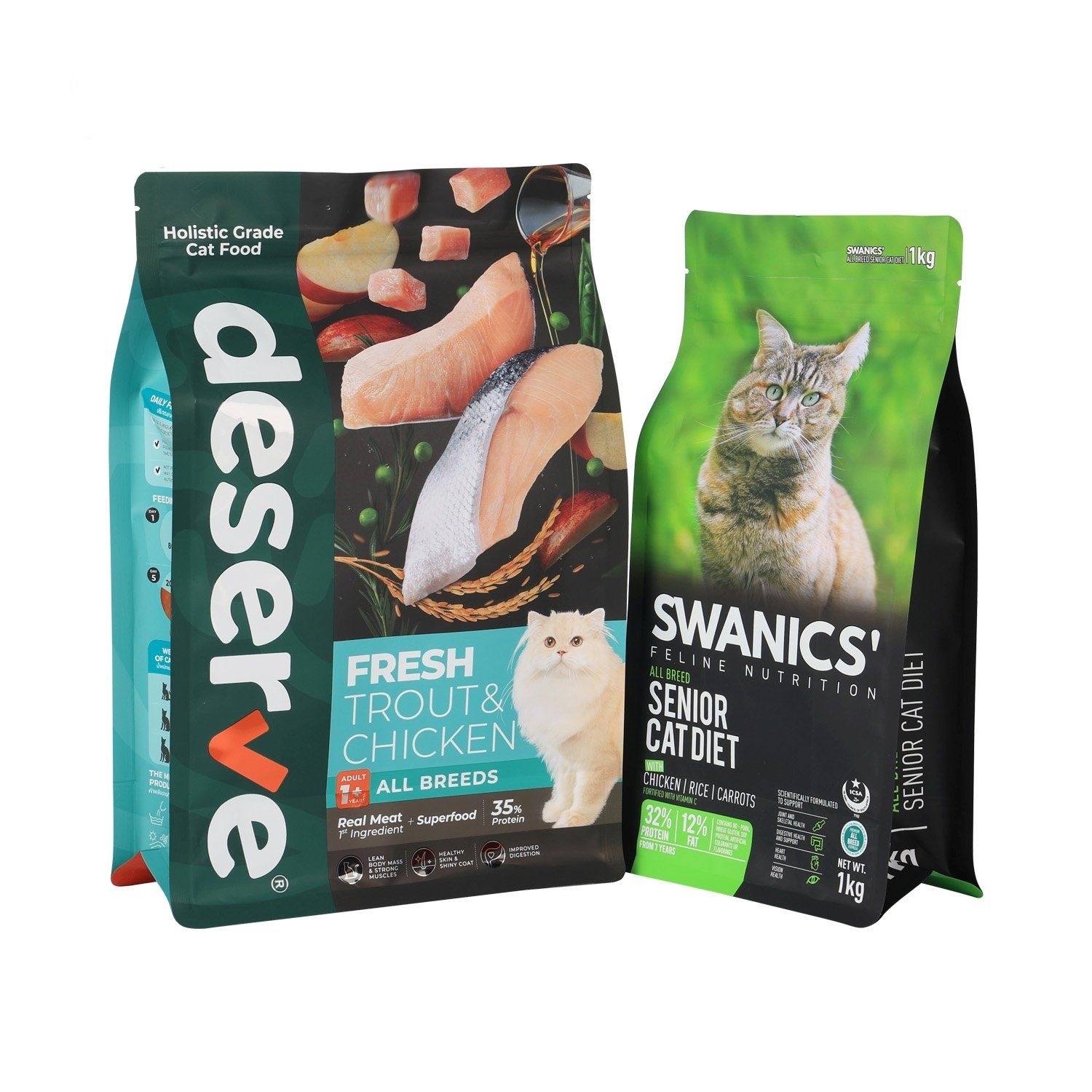
We must explain the structural mechanics of Flat Bottom Bags clearly. They dominate the premium sector for precise mechanical reasons. Their flat base provides exceptional physical support. The rigid sealed corners distribute internal product weight perfectly. This architecture easily manages the extreme stiffness of aluminum foil (AL) layers. It also supports metallized PET (VMPET) without structural buckling. You avoid micro-punctures at the gusset folds completely. Micro-punctures are a common failure point in cheaper side-gusset bags. These tiny holes let oxygen destroy the delicate fats inside.
You must also consider the volume to footprint ratio. This box-like design maximizes internal volume for dense, heavy kibble. Simultaneously, it maintains a highly compact retail footprint. Supermarkets love them. They fit neatly on crowded shelves. They stack predictably in warehouses without toppling over.
Consumer interaction greatly improves. The rigid opening makes daily scooping much easier. The wide top does not collapse inward during use. This heavily reduces the likelihood of greasy residue getting onto consumer hands. It also prevents messy fat transfer to the delicate sealing zipper. A clean zipper extends the usable life of the product significantly.
Structure alone fails completely without the correct material composition. Buyers need a clear framework for evaluating supplier film specifications. You cannot rely on guesswork.
You must define strict Oxygen Transmission Rate (OTR) and Water Vapor Transmission Rate (WVTR) thresholds. High-fat kibble demands ultra-low transmission rates. These metrics dictate how fast oxygen and moisture penetrate the walls. Low OTR stops fat oxidation dead in its tracks. Low WVTR prevents mold growth inside the bag.
A proper lamination breakdown involves three distinct functions.
Outer Layer: Use matte or gloss PET. It offers excellent external durability. It provides flawless printability for high-definition graphics. It resists scuffing during transit.
Middle Barrier Layer: Choose AL (Aluminum foil) or EVOH (Ethylene Vinyl Alcohol). These materials deliver maximum grease and oxygen blocking. We acknowledge EVOH is much more recycling-friendly today. However, AL still provides the absolute highest, most reliable barrier for extremely oily formulations. Do not compromise on the middle layer.
Inner Layer: Mandate food-grade LLDPE (Linear Low-Density Polyethylene). It guarantees strong heat sealing. It ensures crucial FDA contact compliance. It must be thick enough to resist aggressive internal oil attacks.
Functional additions to the structure prevent product degradation long after purchase. Proper closure systems are your primary retention strategy. A bag left open ruins the enclosed food in days.
Compare the dominant closure systems carefully. Press-to-close zippers, hook-and-loop closures (like Aplix or Velcro), and slider zippers all compete. We strongly recommend hook-and-loop systems for oily kibble. Standard zipper tracks easily foul. They fail completely when clogged with grease. Hard kibble crumbs easily jam the tiny plastic grooves. Hook-and-loop closures push through the grease effortlessly. They engage securely even when contaminated by oily dust.
Clear labeling real estate matters immensely. The five-panel design offers massive practical value here. Brands can clearly display FDA-required nutritional information on the back. You can feature detailed storage instructions on one side gusset. You can place complex ingredient lists on the opposite side. This logical arrangement prevents cluttering your main front display panel. Your marketing team keeps the front clean and impactful. Consumers still find all mandatory health data quickly.
Procurement teams need actionable criteria for shortlisting logic. Ask manufacturers for very specific quality assurance data before signing contracts. Vague promises of quality lead to massive product recalls.
Require specific testing protocols from your shortlisted vendors.
Request burst testing results to verify absolute seal strength under pressure.
Demand extreme drop testing data. This is especially critical for heavy flat bottom designs weighing over ten pounds.
Review accelerated grease-resistance testing. This data simulates long-term shelf life under harsh warehouse temperatures.
You must balance custom needs against production realities. Custom multi-layer laminations require specific Minimum Order Quantities (MOQs). Always factor in long supply chain lead times when planning premium launches. Complex foil laminations take longer to cure and slit properly.
Finally, verify critical safety credentials. Your supplier must hold relevant food safety certifications. Look for BRC, SQF, or ISO 22000 documents. Ensure they are certified specifically for direct pet food contact. A general plastics certification is entirely insufficient for oily animal diets.
Oily kibble undeniably requires a strict dual approach. You must combine heavy-duty barrier films with a highly robust physical structure. Basic wrappers will fail your brand and your customers. Flat Bottom Bags equipped with an AL or EVOH barrier represent the most secure investment. Pair them with a reliable, crumb-resistant hook-and-loop closure system. This combination creates a market-ready package capable of protecting your brand reputation. Your next step is straightforward. Contact your manufacturer immediately. Request their detailed material spec sheets containing actual OTR and WVTR data. Ask for structural samples to conduct your own physical grease-migration tests.
A: It's difficult but improving. Monomaterial PE pouches with specialized EVOH coatings are entering the market, but they currently offer lower grease resistance and structural rigidity compared to traditional mixed-material foil laminations. Test rigorously before adopting.
A: Oils and fats from the kibble are migrating through the inner LLDPE layer and attacking the lamination adhesive. You need a thicker inner layer and a dedicated grease barrier.
A: Yes, typically 15-30% more due to complex manufacturing and higher material usage, but this is offset by reduced product spoilage, fewer consumer complaints, and premium retail positioning.

