
Views: 0 Author: Site Editor Publish Time: 2026-07-23 Origin: Site


Upgrading retail packaging represents a critical margin and branding decision for food manufacturers today. Moving away from standard pillow pouches typically pushes brands toward premium alternatives. You must evaluate two leading formats closely. Food brands constantly weigh the benefits of various flexible packaging structures. Both styles offer superior shelf presence compared to traditional stand-up designs. However, they hold distinct differences in structural integrity, manufacturing complexity, and base unit cost.
Selecting the wrong package type can disrupt your automated filling lines severely. It might also erode your hard-earned profit margins. Many consumer packaged goods companies overlook the mechanical limitations of their existing packaging equipment. We provide an objective, procurement-focused breakdown below. You will learn how to evaluate these formats properly. Our guide helps align your choice alongside product weight, expected profit margins, and specific filling line capabilities. Let us explore the nuances of these advanced structural designs to help you optimize retail performance.
**Quad seal bags** deliver exceptional durability and shape retention for heavy fills (e.g., coffee, flour) at a highly scalable unit cost.
The **flat bottom pouch** (or box pouch) offers a true flat base for unmatched unassisted standing stability and provides five full panels for branding, but comes with higher tooling and unit costs.
Equipment compatibility dictates the final choice: flat bottom pouches often require specific automated filling setups due to their rigid box-like structure, whereas quad seal formats are highly adaptable.
Understanding the fundamental engineering behind these two pouch styles is essential. The converting process defines how each bag behaves during transit and retail display. Manufacturers use different web-feeding mechanisms to create these distinct shapes. Let us examine the physical anatomy of each option.
Engineers construct quad seal bags using vertical seals along all four corners. This manufacturing approach creates a rigid, squared-off appearance. The design typically incorporates a fold-over or pinch-bottom gusset at the base. These four vertical pillars create a highly reinforced structured shape. This architecture actively prevents the flexible film from bulging outward. Product settling often causes cheaper standard bags to look distorted. The quad seal design maintains a crisp, uniform silhouette regardless of internal settling.
The flat bottom pouch utilizes a completely flat, rectangular base. Industry professionals often refer to it as a block bottom or box pouch. This design folds out symmetrically to create a 360-degree branding canvas. You get five distinct printable panels. These include the front, back, left gusset, right gusset, and the completely flat bottom panel. The resulting shape closely mimics a traditional rigid cardboard box. However, it retains the lightweight benefits of flexible packaging films.
You must note the significant difference in film consumption between these styles. Box pouches require highly complex web-feeding alignment during the converting process. The machinery folds and glues the flat bottom panel using intricate tooling. This specialized folding directly increases base material waste during setup. It also slows down the overall production web speed. Consequently, base material costs run higher for block bottom designs. Quad seal formats utilize a more straightforward folding process. They consume less raw film material overall. This efficiency translates directly into better base unit pricing for high-volume orders.
To summarize the structural components, consider these standard elements:
Side Gussets: Both formats utilize expanding side panels for increased interior volume.
Corner Seals: Both formats heat-seal the four vertical edges for improved rigidity.
Bottom Construction: The primary differentiator lies entirely in the base folding technique.
Top Closure: Both styles easily accept standard press-to-close zippers or tin ties.
Shelf presence heavily influences consumer purchasing decisions in crowded grocery aisles. Your packaging acts as a silent salesperson. Both formats elevate a brand above basic pillow pouches. However, they deliver different visual merchandising advantages. We must analyze how these bags interact visually in retail environments.
Modern food marketing requires ample space for nutritional claims and brand storytelling. The flat base design offers five seamless, uninterrupted printable panels. This configuration proves ideal for premium brands. The bottom panel remains highly visible when retailers stock the product on lower shelves. Shoppers looking down can read your branding effortlessly.
Conversely, quad seal designs offer four clear printable panels. The bottom seal typically undergoes a crimping or folding process. This mechanical fold removes the bottom panel as viable marketing space. You must rely entirely on the front, back, and side gussets for consumer communication. Most brands find four panels completely sufficient. However, luxury items often leverage the fifth bottom panel for scanning barcodes or printing secondary logos.
You must assess how both bags perform when partially empty. Consumers judge brand quality long after the initial purchase. Box pouches remain perfectly upright with zero lean. Their box-like center of gravity ensures unmatched unassisted standing stability. The flat base provides constant ground contact.
Quad seal designs stand exceptionally well when fully packed. The heavy internal product pushes the bottom gusset flat. However, they may lean or fold slightly as the consumer uses the product. The bag loses its internal stabilizing pressure over time. Unless stabilized by a heavy product weight, half-empty bags might tip over in residential pantries.
Below is a comparative breakdown of shelf performance metrics.
Performance Metric | Quad Seal Format | Block Bottom Format |
|---|---|---|
Printable Panels | Four visible panels | Five visible panels |
Full Bag Stability | Excellent | Exceptional |
Emptying Stability | Moderate (prone to leaning) | High (remains upright) |
Lower Shelf Visibility | Standard forward-facing | Enhanced downward visibility |
Matching the packaging structure to your specific product density ensures operational success. Dropping heavy items into lightweight bags causes catastrophic seam failures. Conversely, packing lightweight items into heavy-duty bags wastes valuable budget. You must align the physical physics of your food product alongside the correct pouch architecture.
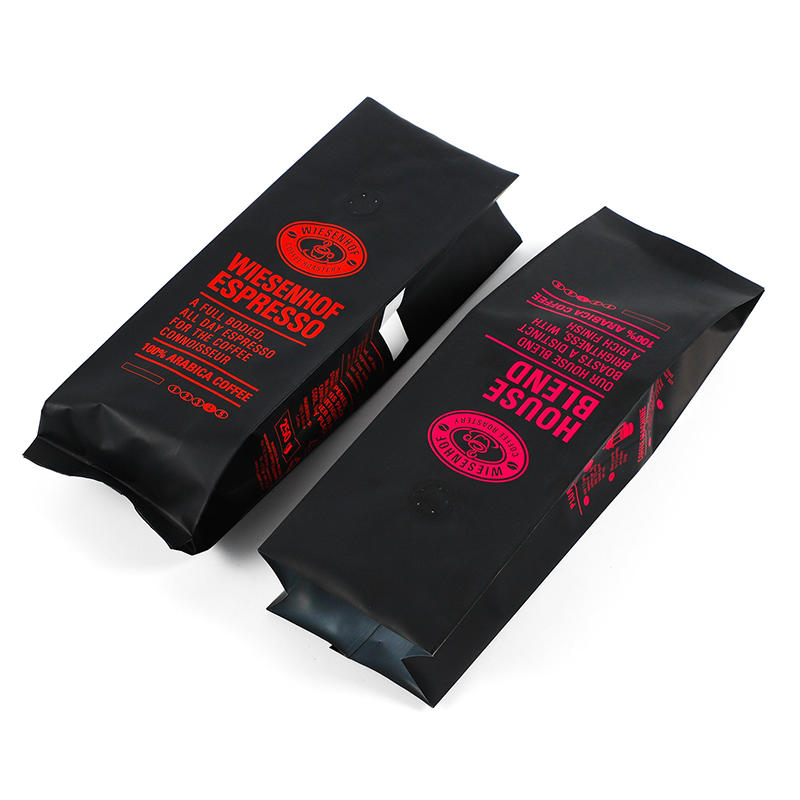
Four-corner sealed bags serve as the undisputed industry standard for bulk goods. We see them used universally for roasted coffee beans, dry pet food, and heavy protein powders. The four vertical corner seals act as engineered structural pillars. They actively prevent the bag from rupturing under high internal pressure. Dropping a three-kilogram bag of dog food puts immense stress on bottom seals. The pinched bottom design absorbs this kinetic energy beautifully. It provides superior drop-test performance for dense bulk items.
Common applications for this heavy-duty format include:
Bulk roasted coffee and green coffee beans
Commercial bakery flour and dry mixes
Premium dry pet kibble and cat litter
Large-format agricultural fertilizers
Block bottom pouches excel primarily with lightweight, premium consumer items. We highly recommend them for artisanal granola, specialty loose-leaf teas, and freeze-dried snacks. These products possess low density but require high aesthetic appeal. The superior shelf aesthetics easily justify the higher packaging cost per ounce. Lightweight products do not exert enough internal downward pressure to flatten a standard pinched gusset. Therefore, a pre-formed flat base guarantees the bag stands perfectly upright immediately after filling.
Shelf-life extension remains a top priority for food brands. Fortunately, both formats easily accommodate high-barrier composite films. Converters can laminate aluminum foil, EVOH, or metallized PET into either shape. Furthermore, both styles readily accept one-way degassing valves for coffee applications. This means your shelf-life outcomes remain entirely identical if you utilize the exact same material specifications. Your decision should rest purely on mechanical structure rather than barrier performance.
Best Practices: Always match your barrier film thickness to the bag size. Larger volumes require thicker gauge films to prevent puncture, regardless of the base style.
Procurement teams must carefully balance marketing desires against operational realities. Choosing the most visually appealing bag might destroy your quarterly margins. You need to calculate the direct manufacturing premiums alongside potential production bottlenecks. Let us break down the economic realities of these two styles.
Box pouches are significantly more complex to manufacture. Converters must utilize highly specialized bag-making machines. These machines operate at slower speeds to ensure the base folds perfectly square. You should expect a 15% to 30% premium in unit cost over equivalent four-corner seal designs. This premium impacts your bottom line directly. Brands must decide if the fifth branding panel generates enough extra sales to offset this ongoing structural premium.
Tooling setups for flat bases require extensive machine calibration. Converters waste hundreds of meters of film simply aligning the folding mechanisms. Because of this expensive setup phase, custom flat base bags often carry much higher MOQs. Suppliers need large runs to justify the setup time. Conversely, four-corner seal bags remain much more accessible. They represent a safer choice for mid-market brands or pilot product launches. You can secure lower MOQs, freeing up vital cash flow during initial market testing.
Production line compatibility often dictates the final packaging decision. You must audit your co-packer’s equipment before ordering custom bags.
Caution: Box pouches can act stubbornly on standard automated pick-fill-seal (PFS) lines. Their complex base gussets are inherently stiff. Suction cups sometimes struggle to open the bag completely before the filling funnel descends. This leads to product spillage and excessive line downtime.
Four-corner seal bags generally integrate seamlessly into existing equipment. They run beautifully on standard vertical form-fill-seal (VFFS) machinery. They also function reliably on pre-made pouch lines. You will experience minimal downtime or expensive re-tooling requirements. Their straightforward top opening allows mechanical grippers to function without interference.
Common Mistakes: Do not order a rigid box pouch without first sending a physical blank sample to your co-packer for a mechanical line trial.
Moving from technical specifications to a final procurement choice requires clear criteria. We have distilled the evaluation process into a straightforward decision framework. Review your product characteristics against these specific operational triggers.
Your product is heavy or highly dense (e.g., 2lb+ coffee or pet food).
You require a premium retail look but need to strictly control base unit economics.
Your brand prioritizes structural strength and puncture resistance over 360-degree branding.
You plan to use high-speed VFFS automated filling lines.
You are launching a high-margin, luxury food product where packaging acts as the primary differentiator.
You need maximum billboard space (5 panels) to convey complex nutritional or brand storytelling.
Your product is lightweight and prone to tipping over in standard gusseted bags.
Your retail strategy heavily relies on lower-shelf product placement.
Theoretical knowledge must give way to physical testing. Always request physical prototypes of both formats from your flexible packaging supplier. Fill them manually with your exact product volume. Run internal drop-tests from standard shelf heights to verify seam integrity. Send filled samples to your retail partners to gather merchandising feedback. Complete these physical validation steps before committing to expensive printing plate fees or high MOQs.
Consider utilizing the matrix below to finalize your packaging direction alongside your team.
Product Category | Recommended Format | Primary Justification |
|---|---|---|
Heavy Pet Food (3kg+) | Four-Corner Seal | Maximum drop-test strength and seam durability. |
Luxury Tea (100g) | Box Pouch | Premium aesthetic, perfectly upright on shelf. |
Bulk Coffee (1kg) | Four-Corner Seal | Cost-effective volume packing, excellent barrier. |
Artisanal Snacks (250g) | Box Pouch | Maximum branding space for premium pricing. |
The choice between these two advanced packaging formats requires a careful calculation of margin, product density, and retail environment. Neither style is objectively superior in a vacuum. Your decision hinges entirely on aligning structural engineering with your commercial goals. Four-corner designs deliver rugged dependability and cost efficiency for heavy goods. Conversely, flat base designs offer unmatched visual merchandising for lightweight luxury items.
Moving forward, audit your co-packer’s filling capabilities to avoid downstream production bottlenecks. Align your packaging investment directly with your target retail price point. Lastly, prioritize physical prototype testing to ensure the chosen format performs perfectly under real-world conditions.
A: Yes. In packaging procurement, flat bottom, block bottom, and box pouches are interchangeable terms for a bag with a completely flat, rectangular base and five printable panels.
A: Yes, the weight of the product flattens the bottom gusset, allowing the bag to stand upright. However, their unassisted stability is slightly lower than a flat bottom pouch, especially as the product is consumed.
A: Quad seal bags are universally easier to integrate into standard pouch-filling equipment. Flat bottom pouches may require specialized suction or opening mechanisms to ensure the square bottom fully expands before the product drops.

