
Views: 0 Author: Site Editor Publish Time: 2026-08-04 Origin: Site


Selecting the wrong spout size for flexible packaging creates a cascade of operational and financial failures. Bottlenecked filling lines, product leakage, and a poor consumer dispensing experience directly impact profitability and brand reputation. Brands often treat spout selection as an afterthought, leading to a critical mismatch between fluid viscosity, filling machinery capabilities, pouch capacity, and end-user requirements. Choosing the right spout requires a technical evaluation framework. You must align the inner diameter, spout geometry, material compatibility, and cap type to ensure seamless manufacturing and optimal product performance. This guide breaks down the engineering criteria necessary to specify the correct spout dimensions for your flexible packaging projects, ensuring you avoid costly production errors and deliver a functional product to the end user.
Viscosity Dictates Diameter: Low-viscosity liquids require narrow spouts to prevent spilling, while high-viscosity or particulate-heavy products demand wider diameters to avoid clogging.
Pouch Capacity Limits Spout Dimensions: The physical dimensions of the pouch (width, height, and gusset) mathematically limit the size of the spout’s sealing base (canoe).
Throughput vs. Geometry: Top-mounted spouts generally allow for higher filling speeds compared to corner-mounted spouts, directly impacting production costs.
Strict Safety Compliance: Spout pouches for baby food require specific, standardized choke-proof caps and ergonomic designs that meet stringent regulatory standards.
Manufacturing Tolerances Matter: Standard plastic spouts operate on strict nominal inner diameters; a variance of even 0.1mm can compromise seal integrity and filling line compatibility.
Before specifying a diameter, you must define the operational parameters of the packaging. The end-user dispensing mechanics dictate how the consumer interacts with the product. Direct consumption requires different spout ergonomics than pouring a bulk liquid into a secondary container or controlling the dosing of concentrated chemicals. You need to map out the exact user journey from opening the cap to dispensing the final drop.
Pouch volume and dimensional constraints physically limit your options. The target volume and physical dimensions—specifically the width, height, and bottom gusset—dictate the maximum allowable footprint of the spout's sealing base. A large spout base cannot physically fit into a narrow pouch gusset without causing structural failure. You must calculate the internal volume geometry against the rigid plastic displacement.
Product shelf-life and barrier needs also influence selection. Spout size and material integration impact the overall oxygen and moisture barrier of the pouch. Multi-layer laminates containing PET, Nylon, Aluminum, or PE must bond perfectly with the spout material to maintain barrier integrity. If the spout material does not match the inner sealant layer of the film, you will experience microscopic channel leaks.
To properly frame the problem, consider the following dimensional constraints when designing pouches with spouts:
Target Pouch Volume | Typical Pouch Width | Maximum Recommended Canoe Width | Common Application |
|---|---|---|---|
50ml - 100ml | 60mm - 80mm | 40mm | Energy gels, single-serve purees |
200ml - 500ml | 90mm - 130mm | 60mm | Beverages, sauces, liquid soaps |
1L - 2L | 150mm - 200mm | 90mm | Bulk condiments, motor oil, refill packs |
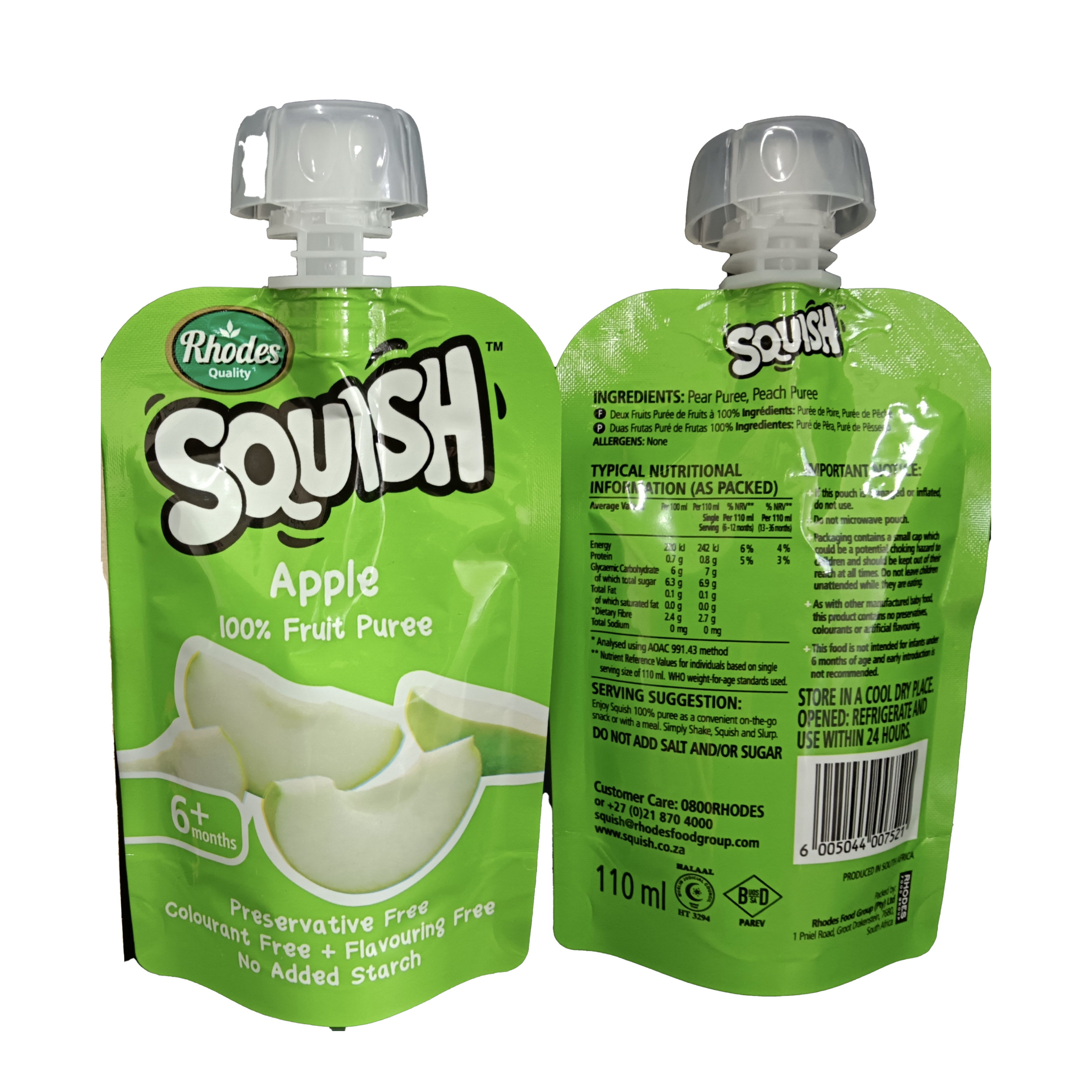
Standard small-diameter spouts, typically ranging from 8.6mm to 10mm, handle low-viscosity liquids effectively. Smaller diameters provide necessary flow control. They prevent accidental spillage during consumption, ensuring the user does not receive a sudden rush of liquid when squeezing the pouch. When dealing with fluids under 100 centipoise (cP), a narrow aperture is mandatory for user control.
You must also consider the surface tension of the liquid. Water-like fluids will leak easily if the cap seal is not perfectly matched to the spout face. The 8.6mm standard is ubiquitous in the beverage industry because it balances flow rate with a small enough opening to drink from directly.
Thicker products necessitate mid-range diameters, usually between 15mm and 22mm. These wider openings reduce the extrusion force required by the user. Forcing thick emulsions through an undersized spout creates shear stress, which increases the risk of product separation or structural damage to the pouch. If a consumer has to use two hands to squeeze out mayonnaise, the spout is too small.
When evaluating medium viscosity products (1,000 to 10,000 cP), you must test the extrusion force. The goal is a smooth, continuous ribbon of product. If the product spurts or requires excessive pressure, step up to the next standard diameter.
Products containing seeds, fruit chunks, or boba require specific sizing frameworks. You must calculate the maximum particulate size against the spout's nominal inner diameter to prevent blockages. Typically, these applications demand spout diameters ranging from 22mm to 33mm or larger to ensure smooth dispensing.
Measure the largest possible particulate in your product formulation.
Multiply that measurement by a factor of 2.5 to determine the absolute minimum inner diameter.
Select the next largest standard spout size available from your manufacturer.
Conduct a physical extrusion test with a prototype pouch to verify no bridging or clogging occurs at the spout base.
Spout Pouches for Baby Food demand strict adherence to safety standards. Mandatory dimensional requirements dictate that baby food caps must exceed standard tracheal diameters to prevent choking hazards. The integration of tamper-evident rings must also interact flawlessly with the spout base without creating small, breakable parts. The standard choke-proof cap is typically 33mm in outer diameter, even if the inner spout opening is only 9mm.
You must evaluate the thermal resistance of spout materials during hot-fill, pasteurization, or retort sterilization processes. The components must withstand high temperatures without warping. Furthermore, the necessity for BPA-free, food-grade polypropylene (PP) or polyethylene (PE) components is non-negotiable for infant nutrition products. If you are retorting the pouches at 121°C, standard PE spouts will melt; you must specify high-density PP.
Designing for this category requires analyzing a specific trade-off. The spout must remain small enough for a toddler's mouth to consume purees safely. Simultaneously, the opening must be wide enough to allow parents to squeeze the contents efficiently without excessive force. The industry has largely settled on a 9mm to 10mm inner diameter as the optimal balance for puree viscosity and infant ergonomics.
Center-top placement remains the industry standard for automated, high-speed filling lines. Top spouts allow for easier rail alignment and symmetrical weight distribution during the filling process. Corner spouts offer easier pouring for large-format pouches but often result in a corresponding reduction in filling speed due to asymmetrical handling requirements.
Spout Placement | Filling Speed Potential | Machinery Alignment | Best Use Case |
|---|---|---|---|
Center Top | High (up to 200+ ppm) | Symmetrical, easy rail tracking | Beverages, baby food, high-volume runs |
Corner | Medium (slower indexing) | Asymmetrical, requires specialized grippers | Large format liquids, motor oil, bulk refills |
A direct mathematical relationship exists between the inner diameter and the volumetric flow rate during the filling process. Narrow spouts require slower fill times. Attempting to force high volumes through a small opening causes product foaming, splashing, or aeration, which compromises seal integrity and product quality. If your filling nozzle is 8mm, you cannot use an 8.6mm spout without risking severe splash-back; you need adequate clearance for air displacement.
You must match the spout's external flange dimensions to the existing guide rails on automated pouch filling equipment. If the flange does not fit the rails, the machinery cannot handle the pouches, rendering the packaging useless for automated production lines. Always request the rail specifications from your co-packer before finalizing the spout design.
Industry-standard inner diameters provide a baseline for selection. The 8.6mm and 10mm sizes typically serve beverages and thin liquids. The 15mm and 22mm sizes handle sauces and gels, while 33mm sizes accommodate particulate-heavy products and bulk dispensing. Sticking to these standard sizes ensures you have multiple supplier options and avoids custom tooling charges.
Plastic injection molding for spouts operates under strict engineering realities. A tolerance deviation of just 0.1mm can lead to filling nozzle misalignment. This slight variance results in product spills or crushed spouts on the production line, causing significant downtime and waste. You must demand strict quality control documentation from your spout manufacturer regarding their mold tolerances.
The "canoe" or "boat" base design of the spout requires precise mathematical alignment with the pouch gusset and film thickness. If the base width does not match the pouch dimensions, achieving a hermetic seal becomes impossible, leading to inevitable product leakage. The heat sealing jaws must apply uniform pressure across the entire width of the canoe.
Critical clearance zones exist around the spout sealing area. Custom printed inks, coatings, and varnishes must remain outside these zones. Contamination in the sealing area prevents the thermal welding process from forming a strong bond, resulting in seal weakness. Always leave a minimum of 5mm unprinted clear space around the entire spout insertion zone.
Creating a hermetic seal requires matching the spout's polymer base with the pouch’s innermost sealant layer. For example, you must pair a Polyethylene (PE) spout with a Linear Low-Density Polyethylene (LLDPE) inner film layer. Mismatched polymers will not fuse correctly. You cannot weld a PP spout to a PE film layer; the melting points are too different, resulting in a weak mechanical bond rather than a true chemical weld.
The manufacturing process demands a precise balance of temperature, pressure, and dwell time. These parameters melt and fuse the rigid spout canoe to the flexible barrier laminate. Incorrect settings cause film burn or structural thinning, weakening the final package. The sealing jaws must be custom-machined to match the exact profile of the spout canoe to ensure even pressure distribution.
The transition zone where the rigid spout meets the flexible film represents the primary failure point in Pouches with Spouts. Mitigate this risk by requesting burst testing and vacuum leak testing during the prototyping phase to verify seal strength before mass production. You should also conduct drop tests from standard retail shelf heights to ensure the spout does not puncture the film upon impact.
Defaulting to a larger spout "just to be safe" carries financial risks. Oversized spouts increase resin costs, shipping weight, and the overall carbon footprint of the packaging. Precise sizing eliminates unnecessary material waste and controls per-unit costs. A 22mm spout uses significantly more plastic than a 10mm spout, which adds up quickly over a run of one million units.
Incorrect thread matching or improper torque application during capping leads to severe issues. Over-torquing strips the threads, while under-torquing compromises the tamper-evident bands and allows product leakage during transit. You must calibrate your capping machinery to the exact inch-pounds of torque specified by the spout manufacturer.
Choosing the correct spout size requires a strict engineering calculation balancing product viscosity, pouch dimensions, machinery limits, and user safety. It is not a subjective design choice. Follow these next steps to ensure successful implementation:
Determine product viscosity and maximum particulate size to establish the minimum inner diameter.
Match physical pouch dimensions with compatible spout canoe sizes to ensure structural integrity.
Identify filling machinery rail and nozzle constraints to guarantee automation compatibility.
Request physical spout samples and conduct flow-rate testing on actual filling equipment before committing to a full production run.
A: Standard spout sizes for thin liquids and beverages typically range from 8.6mm to 10mm. This diameter provides adequate flow control for direct consumption while preventing accidental spillage.
A: Wider inner diameters allow for faster, splash-free volumetric filling. Narrow spouts restrict flow, requiring slower fill times to prevent product foaming or aeration during the automated filling process.
A: Baby food purees generally utilize standard 9mm to 10mm inner diameters. However, the critical requirement is the specialized anti-choke cap, which must exceed standard tracheal dimensions to ensure infant safety.
A: Yes, provided the materials are specified correctly. Polypropylene (PP) spouts and compatible high-temperature laminate films withstand hot-fill and retort sterilization processes without warping the spout geometry or degrading the seal.
A: The inner diameter is measured across the widest point of the spout's internal circular opening. This measurement determines the maximum flow rate and must accommodate the filling nozzle dimensions.
A: Leaks at the base usually occur due to mismatched polymers between the spout and the pouch film, incorrect thermal welding parameters, or a canoe width that is too large for the pouch gusset.

