
Views: 0 Author: Site Editor Publish Time: 2026-08-09 Origin: Site


The adoption of flexible packaging has transformed infant nutrition. Brands and manufacturers face a complex challenge. They must balance consumer demand for on-the-go convenience with strict regulatory compliance. Material safety standards and valid pediatric concerns regarding oral development require rigorous scrutiny. Nutritional transparency is also a major factor in product development. Addressing these challenges requires a comprehensive understanding of packaging engineering and clinical guidelines. This guide provides a technical and operational evaluation of using flexible packaging for infant purees. We analyze material requirements, developmental impacts, manufacturing scalability, and risk mitigation strategies. You will learn how to ensure product integrity and maintain consumer trust while scaling production. By examining the intersection of material science and pediatric recommendations, we establish a clear framework for evaluating these packaging formats.
Material Safety is Non-Negotiable: Viable spout pouches for baby food require strict adherence to BPA-free, phthalate-free, food-grade materials capable of withstanding retort sterilization.
Cap Design Dictates Compliance: Anti-swallow (choke-proof) caps and tamper-evident seals are mandatory structural requirements for infant-targeted packaging.
Developmental Trade-Offs Influence Product Positioning: While direct spout-sucking offers convenience, pediatric guidelines strongly recommend dispensing pouch contents onto a spoon to support oral motor skill development.
Nutritional Transparency Mitigates Brand Risk: Recent high-profile industry investigations highlight the necessity of accurate labeling regarding sugar content and nutritional density in pouch-based purees.
Infant food packaging must meet stringent non-negotiable criteria before it ever reaches a filling line. Barrier protection against oxygen and moisture is the primary defense against spoilage. Oxygen transmission rates (OTR) and water vapor transmission rates (WVTR) must be kept near zero to maintain nutritional integrity and prevent oxidation of sensitive ingredients like pureed fruits and vegetables. Structural integrity during transit ensures the product survives the supply chain without bursting or leaking. Zero-leaching material composition guarantees that no harmful chemicals migrate into the food under any temperature conditions. These baseline requirements form the absolute foundation of safe and effective packaging solutions for vulnerable consumer demographics.
Beyond basic barrier properties, the packaging must also resist puncture and flex-cracking. During distribution, boxes of purees are subjected to vibration, compression, and impact. The laminate structure must absorb these forces without compromising the hermetic seal. Manufacturers rely on rigorous drop testing and vibration simulation to validate the structural design before commercial rollout.
There is a constant tension between the parent's need for portable, mess-free feeding and established pediatric recommendations. Parents favor flexible packaging for its undeniable convenience during travel and busy daily routines. The ability to toss a sealed puree into a diaper bag without fear of glass breakage is a massive operational advantage for families. Conversely, clinical guidelines prioritize traditional spoon-feeding mechanics. Pediatricians emphasize that eating from a spoon supports oral motor skill development, which is necessary for speech and proper chewing.
Balancing these competing needs requires thoughtful product design and clear consumer messaging. Brands must acknowledge the convenience factor while actively promoting healthy feeding habits. This often involves designing packaging that accommodates both direct consumption and easy dispensing onto a spoon. The physical design of the spout and the viscosity of the puree both play roles in how the product is ultimately consumed.
The market has seen a massive transition from heavy glass jars to flexible packaging formats. This shift is driven by weight reduction, logistical efficiencies, and shelf-space optimization. Flexible packaging significantly lowers shipping weights, which directly reduces freight costs and carbon emissions during transport. Furthermore, flexible formats eliminate the risk of glass shards on the production floor and in the consumer's home.
Packaging Attribute | Traditional Glass Jars | Flexible Spouted Formats |
|---|---|---|
Weight | High (increases freight costs) | Low (optimizes logistics) |
Breakage Risk | High (safety hazard) | Minimal (puncture resistant) |
Shelf Space Efficiency | Moderate (rigid footprint) | High (packs tightly) |
Consumer Portability | Low (heavy, requires spoon) | High (lightweight, on-the-go) |
These operational benefits, combined with overwhelming consumer preference, solidify the dominance of flexible solutions in the infant nutrition sector. Retailers also prefer flexible formats because they allow for higher product density on store shelves. The transition is not merely a trend; it represents a fundamental shift in how infant nutrition is processed, distributed, and consumed globally.
Multi-layer structures are necessary to prevent oxidation and extend shelf life without refrigeration. A standard high-barrier laminate often consists of PET/AL/NY/PE. The Polyethylene Terephthalate (PET) provides a printable outer layer and heat resistance. The Aluminum (AL) foil acts as the absolute barrier against light, oxygen, and moisture. Nylon (NY) adds exceptional puncture resistance and mechanical strength. Finally, Polyethylene (PE) serves as the food-contact and heat-seal layer. These laminates provide robust barrier properties against environmental factors.
Transitioning to mono-material recyclable pouches presents significant engineering challenges. Current trade-offs in barrier efficacy must be carefully managed. While EVOH (Ethylene Vinyl Alcohol) can replace aluminum to create a recyclable, all-plastic structure, it is highly sensitive to moisture. If the EVOH layer absorbs water during retort sterilization, its oxygen barrier properties degrade rapidly. Packaging engineers must design complex co-extruded structures to protect the EVOH layer and maintain product safety.
Regulatory frameworks from the FDA, EFSA, and global bodies strictly govern food-contact materials for infants. Strict adherence to BPA-free and phthalate-free standards is mandatory. Manufacturers must source raw resins and adhesives that comply with these regulations. Documentation and traceability are required for every batch of film produced.
Testing protocols for chemical migration under high-heat retort and high-acid conditions ensure that the packaging remains stable. Infant purees often contain high-acid fruits like apples and citrus, which can aggressively attack packaging materials. Migration testing involves exposing the laminate to food simulants at elevated temperatures for extended periods. The simulants are then analyzed using gas chromatography and mass spectrometry to detect any trace chemicals that may have leached from the packaging.
Packaging requirements vary drastically depending on the sterilization process. Hot-fill, cold-fill, and retort sterilization each demand specific material properties. Retort sterilization is the most aggressive method. It subjects the sealed packaging to extreme pressure and temperature fluctuations, often exceeding 121°C (250°F) for up to 60 minutes. The laminate must not delaminate, and the seals must not fail under these harsh conditions.
Pre-heating phase: The chamber temperature rises, increasing internal pressure within the sealed package.
Sterilization hold: The package is held at peak temperature to achieve commercial sterility.
Cooling phase: Cold water is introduced, causing rapid pressure changes that test the burst strength of the seals.
Spout and gusset seals must withstand these conditions without compromising structural integrity. Selecting the appropriate material composition, specifically high-performance retort-grade cast polypropylene (CPP) for the sealant layer, is essential for successful sterilization and long-term shelf stability.
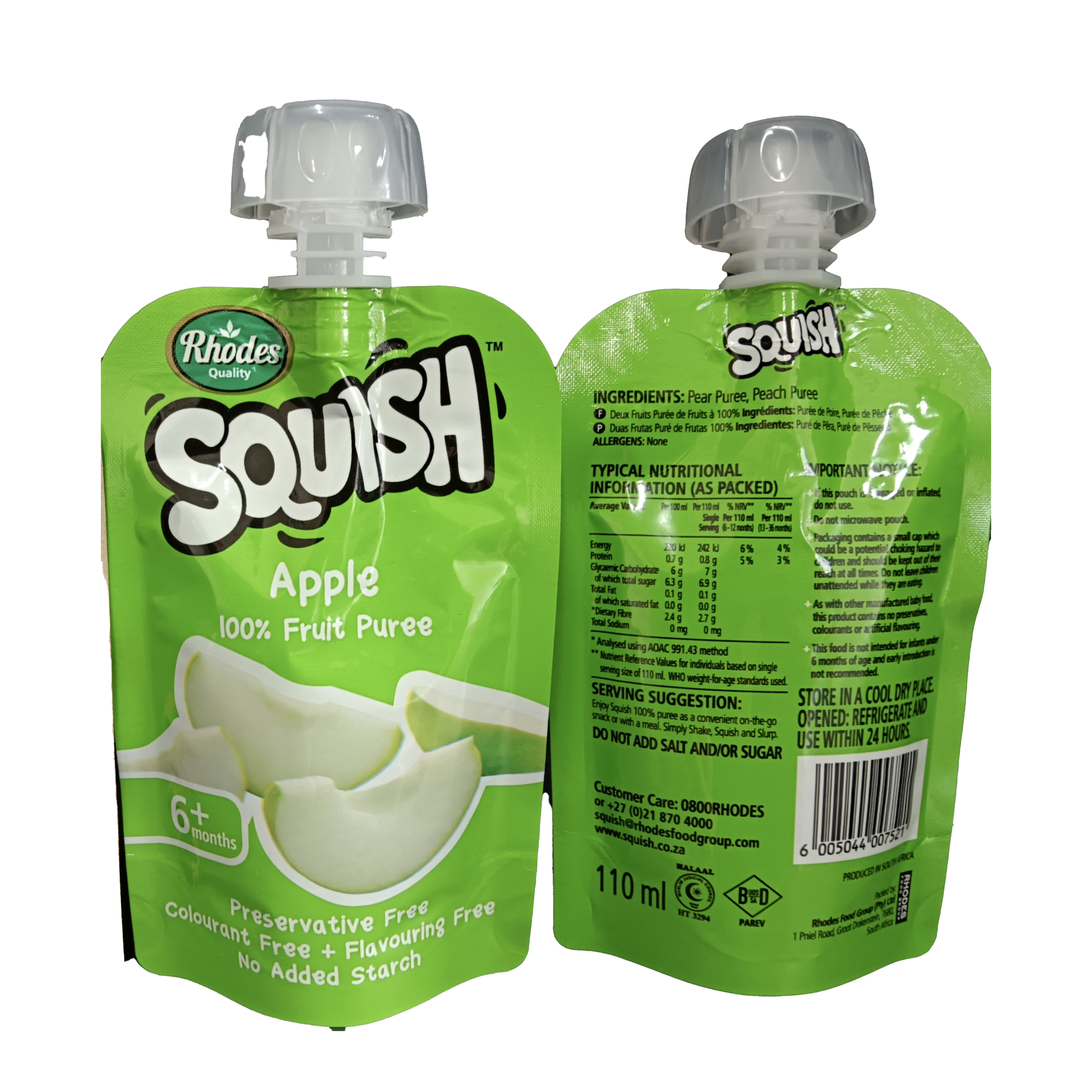
Choke-proof caps are a critical safety feature mandated by consumer safety commissions worldwide. Dimensional requirements dictate oversized designs that prevent accidental swallowing by infants and toddlers. A standard anti-swallow cap typically measures at least 33mm in diameter. This size ensures it cannot pass through a standard small parts test cylinder, which simulates a child's airway.
Furthermore, these caps must feature ventilated designs. If a child somehow manages to lodge the cap in their mouth, the ventilation holes allow air to pass through, mitigating the risk of asphyxiation. These specifications are non-negotiable for any infant-targeted packaging. They require precise injection molding engineering to ensure compliance while maintaining ease of opening for parents.
Integrating breakaway rings guarantees product integrity from the manufacturer to the consumer. Tamper-evident mechanisms provide immediate visual confirmation that the package has not been compromised. When the parent twists the cap for the first time, the plastic bridges connecting the cap to the tamper-evident ring break with a tactile snap.
This feature is vital for maintaining consumer trust and ensuring food safety. If the ring is detached or broken on the store shelf, the consumer knows to discard the product. The engineering challenge lies in designing the bridges to be strong enough to survive the automated capping process but weak enough for a parent to break easily by hand.
Universal thread designs accommodate screw-on spoon attachments. This enables parents to spoon-feed directly from the package during transit. This innovation bridges the gap between convenience and clinical recommendations. By attaching a spoon, the parent can dispense the puree in controlled amounts, encouraging the child to clear the food actively rather than passively sucking it down.
Providing compatible accessories enhances the user experience and supports proper feeding practices. The thread pitch and diameter must be standardized to ensure aftermarket spoons fit securely without leaking. This requires tight tolerances during the injection molding of the spout fitment.
Welding rigid plastic spouts to flexible film presents significant technical challenges. The process requires precise control of heat, pressure, and dwell time. The sealing jaws must melt the inner layer of the film and the outer surface of the spout simultaneously, fusing them into a single hermetic bond. If the temperature is too low, the seal will leak. If it is too high, the film will distort or burn.
Quality control metrics for burst strength and compression testing are necessary to prevent micro-leaks during distribution. Robust spout welding ensures the package remains intact under pressure. Manufacturers utilize automated leak detection systems on the production line to identify and reject any defective seals before they are packed into cartons.
Prolonged spout-sucking bypasses the chewing and swallowing mechanics necessary for speech development and jaw strength. Clinical concerns highlight the difference between infantile suckling and the active process of clearing food from a spoon. When a child sucks puree directly from a nozzle, they rely on a primitive tongue-thrust motion. This does not engage the lateral tongue movements required for chewing solid foods later in life.
Encouraging proper feeding techniques is essential for healthy oral motor skill development. Pediatricians warn that over-reliance on direct sucking can delay the transition to table foods. It can also lead to a preference for highly pureed textures, making children resistant to complex textures like lumps or soft chunks.
Brands can optimize product messaging to encourage dispensing the puree onto a spoon rather than direct consumption. Addressing the logistical realities of on-the-go parent routines provides practical solutions. Packaging artwork should prominently feature illustrations of the product being squeezed onto a spoon or into a bowl. This subtle visual cue reinforces clinical recommendations without alienating parents seeking convenience.
Packing travel spoons or utilizing screw-on dispenser tips offers a middle ground. This approach balances convenience with developmental needs. Brands that actively promote the "squeeze and spoon" method position themselves as responsible partners in child development, which builds long-term brand loyalty among health-conscious parents.
Accurate labeling regarding sugar content and nutritional density is crucial. High-profile investigations have highlighted instances of misleading nutritional claims in the infant food sector. Some products marketed as vegetable-rich actually contain high percentages of cheap, sweet fruit purees like apple or pear to mask the vegetable flavor and boost palatability.
Formulating guidelines for transparent ingredient labeling counters public distrust and protects brand equity. Brands must clearly state the exact percentages of primary ingredients. Evaluating consumer trends around functional additives, like nutrient powders or healthy fats, ensures product relevance. Transparency in labeling is no longer optional; it is a fundamental requirement for survival in the modern infant nutrition market.
Comparing pre-made pouch filling with form-fill-seal (FFS) machinery reveals different operational advantages. Fill-through-spout and fill-through-top methods require specific equipment configurations. Pre-made pouches are supplied already formed with the spout welded in place. The filling machine simply grips the package, removes the cap, fills the product through the spout, and reapplies the cap. This method offers high flexibility and lower initial capital expenditure.
FFS machinery, on the other hand, forms the package from a flat roll of film, inserts and welds the spout, fills the product, and seals the top all in one continuous process. This requires a massive capital investment but offers significantly lower per-unit material costs at high volumes. Evaluating capital expenditure and throughput rates helps manufacturers select the optimal automated packaging lines for their specific production volume and facility constraints.
The unit economics of flexible packaging compared to traditional glass jars demonstrate significant cost advantages. Flexible materials cost less to manufacture, transport, and store. Assessing the margin implications of premium features guides product development. Features such as transparent windows, matte finishes, and sustainable materials add to the manufacturing cost but allow brands to command a higher retail price.
These features can justify higher retail price points while maintaining profitability. A transparent window, for example, requires a specialized barrier film that resists UV degradation, but it provides consumers with visual confirmation of the product's color and texture. This builds trust and often justifies a premium price tag on the shelf.
Common failure points in the supply chain include compromised spout welds or pinholing in the barrier film. Pinholing occurs when the laminate is repeatedly flexed or creased, causing microscopic fractures in the aluminum foil layer. This allows oxygen to enter and spoil the puree. Implementing strict QA/QC protocols mitigates these risks.
Conduct hourly burst testing on the production line to verify seal strength.
Implement automated vision inspection systems to detect misaligned caps or defective welds.
Perform vacuum leak testing on random samples from every batch.
Monitor residual oxygen levels in the headspace immediately after filling.
Ensuring seal integrity is paramount for preventing spoilage and contamination. A single compromised package can lead to a costly product recall and severe damage to brand reputation.
Unsupervised feeding and improper storage pose significant risks, including potential mold growth. If a child consumes half a puree and the parent leaves it at room temperature, bacteria from the child's saliva can rapidly multiply inside the package. Developing clear, legally vetted on-pack warning labels and usage instructions is essential.
Instructions such as "Do not microwave pouch" and "Use under adult supervision" help manage end-user misuse. Microwaving flexible laminates containing aluminum can cause sparking and fires. Even non-foil structures can heat unevenly, creating hot spots that can burn a child's mouth. Clear instructions protect consumer safety and limit manufacturer liability.
Flexible packaging formats are highly viable and efficient for infant nutrition, provided they meet stringent material, structural, and regulatory standards. The transition to these formats requires careful attention to barrier properties, sterilization compatibility, and safety features like anti-swallow caps. By understanding the technical requirements and clinical recommendations, brands can deliver safe, convenient, and developmentally appropriate products.
To successfully implement these packaging solutions, follow these actionable steps:
Initiate compatibility testing with specific puree formulations to verify barrier performance and shelf life.
Audit co-packer capabilities for retort processing and automated leak detection.
Consult with packaging engineers to select the optimal laminate structure, prioritizing high-barrier performance and regulatory compliance.
Design packaging artwork that explicitly encourages dispensing the product onto a spoon to support oral motor development.
A: Yes, provided they are manufactured with BPA-free, food-grade materials, feature anti-swallow caps, and the contents are consumed under adult supervision. Strict adherence to manufacturing standards ensures product safety.
A: Pediatricians generally recommend squeezing the contents onto a spoon or into a bowl to promote proper oral motor skill development, facilitate sensory exploration of food textures, and prevent overconsumption.
A: Yes, many modern packaging designs feature universal thread patterns that allow parents to screw on plastic feeding spoons for clean, convenient feeding while on the go.
A: They typically utilize multi-layer laminated films incorporating PET, Aluminum or EVOH, and PE to provide necessary oxygen and moisture barriers for shelf stability.
A: No. Most flexible packaging contains aluminum layers or plastics not designed for microwave heat, which can cause uneven heating or compromise the packaging.
A: By utilizing oversized, ventilated caps that cannot be easily swallowed and integrating tamper-evident rings that remain attached to the spout base.
A: Traditional multi-layer structures are difficult to recycle, but the industry is rapidly transitioning to mono-material PE or PP structures that are compatible with store drop-off recycling programs.

